
In the name of the Father, and of the Son, and of the Holy Spirit, one God, Amen.
Christ is risen!
“I will walk out in the towns,” I tell myself,
and proclaim the coming of the Christ. Those who ridicule me will get their reward, those who attack me will receive their just deserts, those who follow me will be able to come to Christ through me and my preaching.
And I stand before others and am surprised at their lacklustre response. “This is Truth, this is reality,” I protest, but most would try to ignore me, to walk on by me. But what is worse, in this fantasy I have created, is I believe them to deserve their punishment ahead: “they rejected Christ,” I convince myself, though the reality is that they are rightly rejecting me and my misunderstandings of the Gospel, “they are the ones deserving of the unquenching fire.”
The greatest tragedy of my condition is that I have removed Christ from the centre of my life. Christ is almost incidental to my words, repentance plays no part in my reality: I have set myself up as a guru rather than as a follower of the Way. And the words of the Lord, which should be at the front and centre of any who claim to preach the Gospel, will apply to me.
Not everyone who says to Me, ‘Lord, Lord,’ shall enter the Kingdom of Heaven, but he who does the will of My Father in Heaven.
Matthew 7:21–23
Many will say to Me in that Day, ‘Lord, Lord, have we not prophesied in Your name, cast out demons in Your name, and done many wonders in Your name?’
And then I will declare to them, ‘I never knew you; depart from Me, you who practice lawlessness!’
And so I convince myself, “I will say nothing of the Gospel to anyone,” and yet He speaks directly to me and to each one of us,
All authority has been given to Me in Heaven and on earth.
Matthew 28:18–20
Go therefore and make disciples of all the nations, baptising them in the name of the Father and of the Son and of the Holy Spirit,
teaching them to observe all things that I have commanded you; and lo, I am with you always, even to the end of the age. Amen.
And I feel trapped, I must preach the Gospel and yet I must not preach it. But this false dichotomy is formed because I misunderstand ‘preach:’ we are not called to stand and show off our knowledge about God, we are called to bring others to Him.
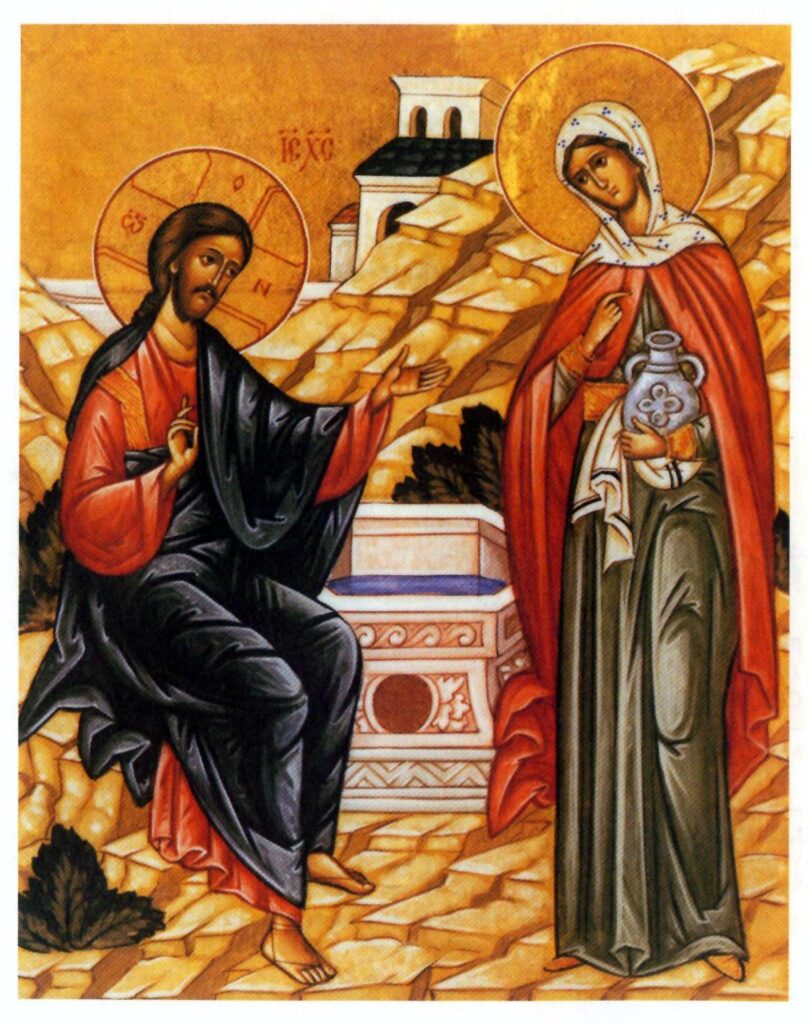
St Photini, the Samaritan Woman, did not return to Sychar with promises of hidden intelligence and methods to a better life, she did not claim to have ‘the secrets of success,’ nor techniques to ‘a better version of you.’ This is not based on what St Photini knows and others do not, she tells the people of the town, “Come, see a man who told me all that I ever did. Can this be the Christ?” And my preaching—knowing clever arguments and refined points of debate—is shown as empty and void. My preaching is about proving how clever I am, hers is about bringing any who would come to Christ before Him that they may have their own encounter with Christ, their own encounter with God.
And so I must change, I must repent of my sin and turn again to the living God. I must have as the centre of my Christian life not just knowledge about Christ but an encounter with the divine which changes me and transforms me, which brings me to repentance for my sin and new Life in Him. And if I do this I will be living in conformity with the Gospel of Christ.
My dear brothers and sisters, we are called to preach the Gospel, not down onto others but as part of our loving relationship with them. This is not about numbers, not about increasing our church size: this is about remaining loyal and faithful to our Lord and Saviour Who was crucified for us that we may be united to Him, Who rose from the dead that we may have Life, Who has called us to be,
a chosen generation, a royal priesthood, a holy nation, His own special people, that we may proclaim the praises of Him who called us out of darkness into His marvellous light;
First Peter 2:9–10
who once were not a people but are now the people of God, who had not obtained mercy but now have obtained mercy.
Let us, dear brothers and sisters in Christ, ever preach the Gospel with our actions, let us love even those who hate us, let us serve all that we may be true followers of our risen Lord and be inheritors of eternal Life.
Christ is risen! He is risen indeed!
That we may offer true praise, glory and worship to our Great God and Saviour Jesus Christ Who has incorporated us into Himself as the Church of God, together with His unoriginate Father and the All-holy, Good and Life-giving Spirit. Amen.
In those days, those apostles who were scattered because of the persecution that arose over Stephen traveled as far as Phoenicia and Cyprus and Antioch, speaking the word to none except Jews. But there were some of them, men of Cyprus and Cyrene, who on coming to Antioch spoke to the Greeks also, preaching the Lord Jesus. And the hand of the Lord was with them, and a great number that believed turned to the Lord. News of this came to the ears of the church in Jerusalem, and they sent Barnabas to Antioch. When he came and saw the grace of God, he was glad; and he exhorted them all to remain faithful to the Lord with steadfast purpose; for he was a good man, full of the Holy Spirit and of faith. And a large company was added to the Lord. So Barnabas went to Tarsus to look for Saul; and when he had found him, he brought him to Antioch. For a whole year they met with the church, and taught a large company of people; and in Antioch the disciples were for the first time called Christians. Now in these days prophets came down from Jerusalem to Antioch. And one of them named Agabos stood up and foretold by the Spirit that there would be a great famine over all the world; and this took place in the days of Claudius. And the disciples determined, every one according to his ability, to send relief to the brethren who lived in Judea, and they did so, sending it to the elders by the hand of Barnabas and Saul.
— Acts 11:19–30
At that time, Jesus came to a city of Samaria, called Sychar, near the field that Jacob gave to his son Joseph. Jacob’s well was there, and so Jesus, wearied as he was with his journey, sat down beside the well. It was about the sixth hour. There came a woman of Samaria to draw water. Jesus said to her, “Give me a drink.” For his disciples had gone away into the city to buy food. The Samaritan woman said to him, “How is it that you, a Jew, ask a drink of me, a woman of Samaria?” For Jews have no dealings with Samaritans. Jesus answered her, “If you knew the gift of God, and who it is that is saying to you, ‘Give me a drink, ‘ you would have asked him and he would have given you living water.” The woman said to him, “Sir, you have nothing to draw with, and the well is deep; where do you get that living water? Are you greater than our father Jacob, who gave us the well, and drank from it himself, and his sons, and his cattle?” Jesus said to her, “Everyone who drinks of this water will thirst again, but whoever drinks of the water that I shall give him will never thirst; the water that I shall give him will become in him a spring of water welling up to eternal life.” The woman said to him, “Sir, give me this water, that I may not thirst, nor come here to draw. Jesus said to her, “Go, call your husband, and come here.” The woman answered him, “I have no husband.” Jesus said to her, “You are right in saying, ‘I have no husband’; for you have had five husbands, and he whom you now have is not your husband; this you said truly.” The woman said to him, “Sir, I perceive that you are a prophet. Our fathers worshipped on this mountain; and you say that Jerusalem is the place where men ought to worship.” Jesus said to her, “Woman, believe me, the hour is coming when neither on this mountain nor in Jerusalem will you worship the Father. You worship what you do not know; we worship what we know, for salvation is from the Jews. But the hour is coming, and now is, when the true worshipers will worship the Father in spirit and truth, for such the Father seeks to worship him. God is spirit, and those who worship him must worship in spirit and truth.” The woman said to him, “I know that the Messiah is coming (he who is called Christ); when he comes, he will show us all things.” Jesus said to her, “I who speak to you am he. Just then his disciples came. They marvelled that he was talking with a woman, but none said, “What do you wish?” or, “Why are you talking with her?” So the woman left her water jar, and went away into the city and said to the people, “Come, see a man who told me all that I ever did. Can this be the Christ?” They went out of the city and were coming to him. Meanwhile the disciples besought him, saying “Rabbi, eat.” But he said to them, “I have food to eat of which you do not know.” So the disciples said to one another, “Has anyone brought him food?” Jesus said to them, “My food is to do the will of him who sent me, and to accomplish his work. Do you not say, ‘There are yet four months, then comes the harvest’? I tell you, lift up your eyes, and see how the fields are already white for harvest. He who reaps receives wages, and gathers fruit for eternal life, so that sower and reaper may rejoice together. For here the saying holds true, ‘One sows and another reaps.’ I sent you to reap that for which you did not labour; others have laboured, and you have entered into their labour. Many Samaritans from that city believed in him because of the woman’s testimony. “He told me all that I ever did.” So when the Samaritans came to him, they asked him to stay with them; and he stayed there two days. And many more believed because of his word. They said to the woman, “It is no longer because of your words that we believe, for we have heard ourselves, and we know that this is indeed Christ the Saviour of the world.
— John 4:5–42