Talk given by P. Alexander Haig at the Retreat of the Antiochian Orthodox Christian Archdiocese of the British Isles and Ireland, October 2025.
Dear brothers and sisters in Christ,
It is a great honour, but also a responsibility, to speak on such a topic—this is something which lies at the very heart of what it is to be Christians, little Christs, that we may live the life commanded of us by the Lord.
What is it to be a Christian?
“I believe in one God,” each one of us said on our reception into the Church, or our God-parents said it on our behalf, “the Father Almighty, Maker of Heaven and Earth.” And when we say this, The Symbol of Faith, The Creed, we are not saying, “I think there is one God,” nor “my opinion is there is one God,” rather we say, “I place my trust in one God, I am loyal to one God, I remain faithful to one God.” It is not our opinions which mark us as Christians, it is not our knowledge of facts about God—indeed, all the facts are now known by the Devil, if it is only about knowing facts then the Devil would be the greatest Christian—rather it is that we are faithful to one God.
“Not everyone who says to Me, ‘Lord, Lord,’” says Christ,
shall enter the Kingdom of Heaven, but he who does the will of My Father in Heaven.
Matthew 7:21–23
Many will say to Me in that Day, ‘Lord, Lord, have we not prophesied in Your name, cast out demons in Your name, and done many wonders in Your name?’
And then I will declare to them, ‘I never knew you; depart from Me, you who practice lawlessness!’
Christ is clear: it is not what we say, our opinions, which will be our defence on the Last Day, it is what we do. Prophesying is not enough, casting out demons nor working wonders, even calling Christ “Lord,” cannot bring about a justification. And on the Sundays before Lent, the Great Fast, the Church sets before us what it is to be a Christian. On the Sunday of the Last Judgement, one week before the start of the Fast, we read,
When the Son of Man comes in His glory, and all the holy angels with Him, then He will sit on the throne of His glory.
Matthew 25:31–36[*]
All the nations will be gathered before Him, and He will separate them one from another, as a shepherd divides his sheep from the goats.
And He will set the sheep on His right hand, but the goats on the left.
Then the King will say to those on His right hand, ‘Come, you blessed of My Father, inherit the Kingdom prepared for you from the foundation of the world:
for I was hungry and you gave Me food; I was thirsty and you gave Me drink; I was a stranger and you took Me in;
I was naked and you clothed Me; I was sick and you visited Me; I was in prison and you came to Me.’
One thing which is interesting in that chapter is there are two other familiar sections, The Parable of the Wise and Foolish Virgins (verses 1–13) and The Parable of the Talents (verses 14–30) both start by indicating directly they are parables, stories for initiated to understand a deeper meaning, “Then the Kingdom of Heaven shall be likened to, … For it is like, …” (verses 1, 14) For the Last Judgement, it is stark, it is explicit, it is not veiled in story nor shrouded in mystery, “When the Son of Man comes in His glory.” And standing before the Throne of our Judge, we are not asked if we have the right opinions, if we know the correct facts, if we are members of the true Church nor how many prayers did we say, rather do we feed the hungry, give drink to the thirsty, take in the stranger, clothe the naked, visit the sick and imprisoned.
Then the righteous will answer Him, saying, ‘Lord, when did we see You hungry and feed You, or thirsty and give You drink?
verses 37–40
When did we see You a stranger and take You in, or naked and clothe You?
Or when did we see You sick, or in prison, and come to You?’
And the King will answer and say to them, ‘Assuredly, I say to you, inasmuch as you did it to one of the least of these My brethren, you did it to Me.’
What is it, then, to be a Christian? The first part of our answer is it is to serve even the least of the brethren, for in serving them we serve Christ. We see Christ in the person standing before us: yes, indeed, in emperors, kings and presidents, in bishops, priests and deacons, in the powerful, in the rich, but also—or, put even better, especially we see Christ—in the poor, the down-trodden, the afflicted, in the least of the brethren with whom Christ identifies.
But there is more. Yes, indeed we must be faithful to one God, but the very next week, on the precipice of the Great Fast, the Church sets before us the second part: we forgive.
For if you forgive men their trespasses, your heavenly Father will also forgive you.
Matthew 6:14–15[†]
But if you do not forgive men their trespasses, neither will your Father forgive your trespasses.
These two verses come in Matthew’s Gospel immediately following the Lord’s Prayer: words we pray regularly, we pray often, words which are so familiar to us it is easy to forget their significance and power.
And forgive us our trespasses,
Matthew 6:12
As we forgive those who trespass against us.
As much as I am willing forgive the person who has offended me and wronged me the most, to that same extent God will forgive me.
“O unspeakable mercy of God,” says St John Cassian, when commenting on this phrase in the Lord’s Prayer,
which has not only given us a form of prayer and taught us a system of life acceptable to Him, and by the requirements of the form given, in which He charged us always to pray, has torn up the roots of both anger and sorrow, but also gives to those who pray an opportunity and reveals to them a way by which they may move a merciful and kindly judgment of God to be pronounced over them and which somehow gives us a power by which we can moderate the sentence of our Judge, drawing Him to forgive our offences by the example of our forgiveness: when we say to Him: ‘Forgive us as we also forgive.’ And so without anxiety and in confidence from this prayer a man may ask for pardon of his own offences, if he has been forgiving towards his own debtors, and not towards those of his Lord.
St John Cassian, Conference 9. The First Conference of Abbot Isaac: On Prayer, XXII,[‡] emphasis added.
For some of us, which is very bad, are inclined to show ourselves calm and most merciful in regard to those things which are done to God’s detriment, however great the crimes may be, but to be found most hard and inexorable exactors of debts to ourselves even in the case of the most trifling wrongs. Whoever then does not from his heart forgive his brother who has offended him, by this prayer calls down upon himself not forgiveness but condemnation, and by his own profession asks that he himself may be judged more severely, saying: Forgive me as I also have forgiven. And if he is repaid according to his own request, what else will follow but that he will be punished after his own example with implacable wrath and a sentence that cannot be remitted? And so if we want to be judged mercifully, we ought also to be merciful towards those who have sinned against us. For only so much will be remitted to us, as we have remitted to those who have injured us however spitefully.
And some dreading this, when this prayer is chanted by all the people in Church, silently omit this clause, for fear lest they may seem by their own utterance to bind themselves rather than to excuse themselves, as they do not understand that it is in vain that they try to offer these quibbles to the Judge of all men, who has willed to show us beforehand how He will judge His suppliants. For as He does not wish to be found harsh and inexorable towards them, He has marked out the manner of His judgment, that just as we desire to be judged by Him, so we should also judge our brethren, if they have wronged us in anything, for ‘he shall have judgement without mercy who hath shown no mercy.’ (James 2:13)
If I may summarise, to be a Christian is two-fold, we must be faithful to God which is to be obedient as Christ was obedient.
Let this mind be in you which was also in Christ Jesus,
Philippians 2:5–11
who, being in the form of God, did not consider it robbery to be equal with God,
but made Himself of no reputation, taking the form of a bondservant, and coming in the likeness of men.
And being found in appearance as a man, He humbled Himself and became obedient to the point of death, even the death of the Cross.
Therefore God also has highly exalted Him and given Him the Name which is above every name,
that at the Name of Jesus every knee should bow, of those in Heaven, and of those on Earth, and of those under the Earth,
and that every tongue should confess that Jesus Christ is Lord, to the glory of God the Father.
We must be faithful that we may participate in the Resurrection, and we demonstrate our faithfulness by what we do much more than what we say, but so that we may rise to glory rather than dishonour, we must forgive.
The Falls and a Path to Redemption
How, then, dear brothers and sisters, did we get here? If this is the ideal, the perfection to which we are called, why do we not do it? Because we fell. And in this I cannot blame Adam nor the Woman: I have the benefit of the Resurrection, of two thousand years of the Church proclaiming the Truth of the defeat of sin, of baptism, chrismation and the eucharist offered regularly, and still I sin, I fall short of the glory of God. The facts of my own life demonstrate that, in their situation, I would have done exactly the same, probably faster and with more serious consequences.
Then the Lord God called to Adam and said to him, ‘Where are you?’
Genesis 3:9–12
So he said, ‘I heard Your voice in the Garden, and I was afraid because I was naked; and I hid myself.’
And He said, ‘Who told you that you were naked? Have you eaten from the tree of which I commanded you that you should not eat?’
Then the man said, ‘The woman whom You gave to be with me, she gave me of the tree, and I ate.’
This is great hubris. Just a few verses earlier we hear,
So when the woman saw that the tree was good for food, that it was pleasant to the eyes, and a tree desirable to make one wise, she took of its fruit and ate. She also gave to her husband with her, and he ate.
verse 6
It does not say, “And Adam came along and saw her eating the fruit and ate also,” he was with her witnessing her dialogue with the Serpent and agreeing with it. Note, too, how he also blames God for bringing this calamity, “The woman whom You gave to be with me:” his impudence—my impudence!—is breathtaking. And the woman, as is so often the case with all of us, follows the crowd, as afraid to take responsibility as Adam, “The serpent deceived me, and I ate.” (verse 13) Both pass on the blame.
And outside Paradise I continue to fall. I have killed my brother (see Genesis 4:1–15) and when the Lord asks where he is I reply, “I do not know. Am I my brother’s keeper?” (verse 9) And I sing alongside Lamech,
Adah and Zillah, hear my voice;
verses 23–24
Wives of Lamech, listen to my speech!
For I have killed a man for wounding me,
Even a young man for hurting me.
If Cain shall be avenged sevenfold,
Then Lamech seventy-sevenfold.
I deny responsibility and I am led inextricably towards death. I attempt to master God but this is foolishness, I attempt to trap Him in what I can understand and know yet He scatters me abroad. (Genesis 11:1–9) Yet God did not leave us in this state, as we hear in the Liturgy we serve during the Great Fast, as well as some other times of the year,
Yet Thou [God] didst not turn Thyself away forever from Thy creature whom Thou hast made, O good One, neither didst Thou forget the work of Thy hands; but Thou didst visit him in diverse manners, through Thy tender mercies. Thou didst send forth prophets; Thou didst perform mighty works by Thy holy ones who, in every generation, were well-pleasing unto Thee; Thou didst speak to us by the mouths of Thy servants the prophets, who foretold unto us the salvation which was to come; Thou didst give unto us the Law as an aid; Thou didst appoint guardian angels. And when the fulness of time was come, Thou didst speak unto us through Thy Son Himself, by Whom also Thou madest the ages, Who, being the Brightness of Thy glory and the express Image of Thy person and upholding all things by the word of His power, thought it not robbery to be equal to Thee, the God and Father.
Anaphora, The Divine Liturgy of St Basil the Great
And in Christ and through Christ, Death is trampled down by death and if we are joined to Him, if we are faithful to Him, if we are crucified in Christ and through Christ then the Resurrection will be ours. Yes I have fallen, yes I have brought death, sin and idolatry into the world, but Christ has bought me back—redeemed me—from the slavery into which I sold myself: I was dead and now I am alive, I was lost and now am found. The Promise given to Abraham has been fulfilled in Christ and if I am baptised into Christ I may participate in the Promise.
The School of Love
“A new Commandment I give to you,” says the Lord,
that you love one another; as I have loved you, that you also love one another.
John 13:34–35
By this all will know that you are My disciples, if you have love for one another.
For in this new Commandment we learn what it is to be loving, to love as Christ has loved us.
Greater love has no one than this, than to lay down one’s life for his friends.
John 15:13
In this fallen world this does not come naturally: I am selfish, I am greedy, I am egotistical. Yet Christ pours out His love—His faithfulness and His forgiveness—upon everyone,
Father, forgive them, for they do not know what they do.
Luke 23:34
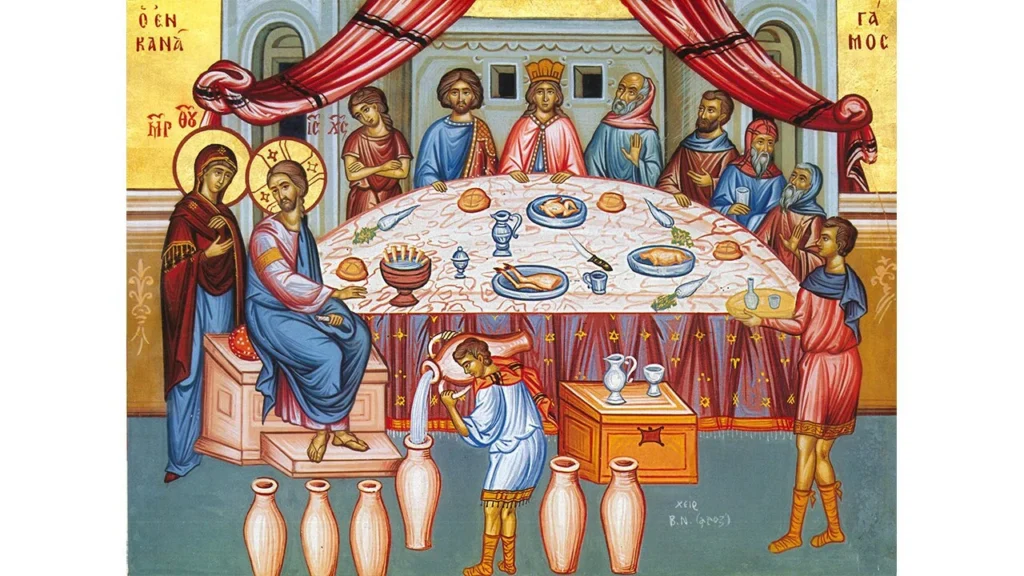
But I cannot do this. It is too much for me to love everyone as Christ has loved us. So the Church, in her great love for us, has given us an institution to practise and to train, she has given to us marriage. Marriage allows for each of us to deny himself, to place himself second. A marriage entered into based on what each person gets out of it is not Christian: saying, “he will provide for me, … she makes a good income so we can buy a house, … his family have good business contacts, … her cooking is not too bad, …” are all abhorrent reasons for marriage and profoundly against the Gospel.
Marriage is about opening our hearts to allow another person to have first place, “here is someone whom I can serve completely, for whom I will give up some of my selfishness.”
“Wives,” says the Apostle,
submit to your own husbands, as to the Lord.
Ephesians 5:22
And we are aghast! But in the ancient world this was not particularly controversial, this was just the way of the world. And in commenting on this, St John Chrysostom says,
[T]here is nothing which so welds our life together as the love of man and wife. For this many will lay aside even their arms, for this they will give up life itself. And Paul would never without a reason and without an object have spent so much pains on this subject, as when he says here, ‘Wives, be in subjection unto your own husbands, as unto the Lord.’ And why so? Because when they are in harmony, the children are well brought up, and the domestics are in good order, and neighbours, and friends, and relations enjoy the fragrance. But if it be otherwise, all is turned upside down, and thrown into confusion. And just as when the generals of an army are at peace one with another, all things are in due subordination, whereas on the other hand, if they are at variance, everything is turned upside down; so, I say, is it also here. Wherefore, saith he, ‘Wives, be in subjection unto your own husbands, as unto the Lord.’
St John Chrysostom, Homilies on Ephesians, XX[§]
But both the Apostle and St John Chrysostom go on.
Husbands, love your wives, just as Christ also loved the Church and gave Himself for her,
Ephesians 5:25–28
that He might sanctify and cleanse her with the washing of water by the word,
that He might present her to Himself a glorious Church, not having spot or wrinkle or any such thing, but that she should be holy and without blemish.
So husbands ought to love their own wives as their own bodies; he who loves his wife loves himself.
And we have already explained what is meant by “Husbands, love your wives,”—it means service, it means sacrifice, it means remaining faithful. St John Chrysostom responds,
Do you wish to have your wife be obedient to you, as the Church is to Christ? Take then yourself the same provident care for her, as Christ takes for the Church. Yes, even if it shall be needful for you to give your life for her, and even to be cut into pieces ten thousand times, yes, and to endure and undergo any suffering whatever,—do not refuse it.
St John Chrysostom, op. cit. I have made some modifications to modernise the somewhat antiquated text.
Though you should undergo all this, yet you will not, no, not even then, have done anything like Christ. For you indeed are doing it for one to whom you are already knit; but He [Christ] for one who turned her back on Him and hated Him. In the same way then as He laid at His feet her who turned her back on Him, who hated, and spurned, and disdained Him, not by menaces, nor by violence, nor by terror, nor by anything else of the kind, but by his unwearied affection; so also behave towards your wife. Though you see her looking down upon you, and disdaining, and scorning you, yet by your great thoughtfulness for her, by affection, by kindness, you will be able to lay her at your feet. For there is nothing more powerful to sway than these bonds, and especially for husband and wife.
A servant, indeed, one will be able, perhaps, to bind down by fear; though not even him, for he will soon start away and be gone. But the partner of one’s life, the mother of one’s children, the foundation of one’s every joy, one ought never to chain down by fear and menaces, but with love and good temper. For what sort of union is that, where the wife trembles at her husband? And what sort of pleasure will the husband himself enjoy, if he dwells with his wife as with a slave, and not as with a free-woman? Indeed, though you should suffer anything on her account, do not upbraid her; for neither did Christ do this.
It is, therefore, with mutual obedience, which requires mutual forgiveness, that we can learn to put less emphasis on ourselves and more on other people. And in doing this towards one person—completely and unequivocably, at least, to the best of our ability—we can become better Christians: more faithful and more forgiving.
But there is even more. Having learned to open our hearts to obey one other, through marriage God may bless us with children. The ordered and peaceful home we have created with our spouse is transformed completely: chaos reigns while sleep deprivation and attention seeking little ones take priority. This is good and for our salvation! We learn to obey and serve not just one who is our equal, our husband or our wife, but one who is, in some sense, below us. “I am greater, more important, than my child,” I convince myself, but when it is he who cannot sleep, or who wants the same story read to him for the hundredth night in a row, or who wants the umpteenth episode of Peppa Pig or Paw Patrol, or who needs comfort after a bad dream, I must serve him. The circle of those I serve grows wider, no longer just my spouse, and I draw closer to Christ. Children are a great blessing to us because through the chaos, the tantrums, the trials, the driving around, the cooking for and the clearing up after—which, on reflection, are all as nothing next to the love and affection, the care and the warmth we receive in compensation daily—through all these things I may become as a better person and more in the likeness of God.
Monasticism
Before drawing to a close, I would make a brief interlude about monasticism. We have seen how the Christian life is about serving others and forgiveness and how this is actualised in the family, firstly with a spouse and then later, potentially, with children. But this goal is the same as in monasticism. The monk gives himself to serving the monastery, in the person of the elder, that he might make room in his heart for another—and this other is expanded, over time, to include more and more so that God may be glorified.
We do not, as the Church, have a “monastic” spirituality and a “lay” spirituality: we are all called to holiness, to be saints. The details may differ, our route to get there may be contrasting, but the result, the destination, is the same.
It should occur to every unmarried Orthodox Christian that monasticism might be the calling from God. While the majority of Christians will end up being married we should all be open to the possibility. As a community, as the Church in Britain and Ireland, we need there to be monks and nuns, we need there to be monasteries to be present to pray for the world and for us to visit. And whether we achieve this by ourselves becoming monks and nuns, by our children becoming monks and nuns or by providing the financial resources necessary for monasteries to be built, this needs to be a priority for us.
Conclusion
The Christian life is the highest calling of mankind and in marriage, along with parenthood, the majority learn to be better Christians. We seek a spouse with whom we work together to enter the Kingdom: this is the meaning of the crowns in the Marriage service—here is given the route, the direction, the means by which we may enter holiness and enter the Kingdom, the crowns of marriage are the foretaste of the Crowns of Righteousness.
“For I am already being poured out as a drink offering,” says the Apostle,
and the time of my departure is at hand.
Second Timothy 4:6–8
I have fought the good fight, I have finished the race, I have kept the faith.
Finally, there is laid up for me the Crown of Righteousness, which the Lord, the righteous Judge, will give to me on that Day, and not to me only but also to all who have loved His appearing.
For those of you who are married, stay the course, fight the good fight, grow in obedience and service to your wife or husband, that you may demonstrate your faith by your faithfulness and so grow in the image of our God and Saviour Jesus Christ. For those who would like to be married, seek someone to whom you will be obedient, whom you are willing to serve daily, whom you are willing to forgive daily, because in this way, by being together faithful to Christ you will together enter the Kingdom of God.
Forgive me.
P. Alexander
[*] The whole reading on that Sunday is verses 31–46.
[†] The whole reading on that Sunday is verses 14–21.
[‡] May be found online, https://ccel.org/ccel/cassian/conferences/conferences.ii.x.xxi.html
[§] Available online, https://ccel.org/ccel/schaff/npnf113/npnf113.iii.iv.xxi.html