
Dear Friends
Some like to think of God as merciful, and mercy in the Bible and in the Church means more than “don’t punish me,” it means be loving and generous; God is the One Who gives, freely and generously, to all who come to Him. Others think of Him as forgiving, the One Who receives all people and lets go of everyone’s sin, no longer holding their wrongdoing against them. Others, still, think of God as vengeful, as punishing the unrighteous—though, often, unrighteousness is only applied to other people—for their sins against God and against their neighbours.
Sometimes two of these are combined, God is merciful and forgiving, merciful and vengeful or forgiving and vengeful.
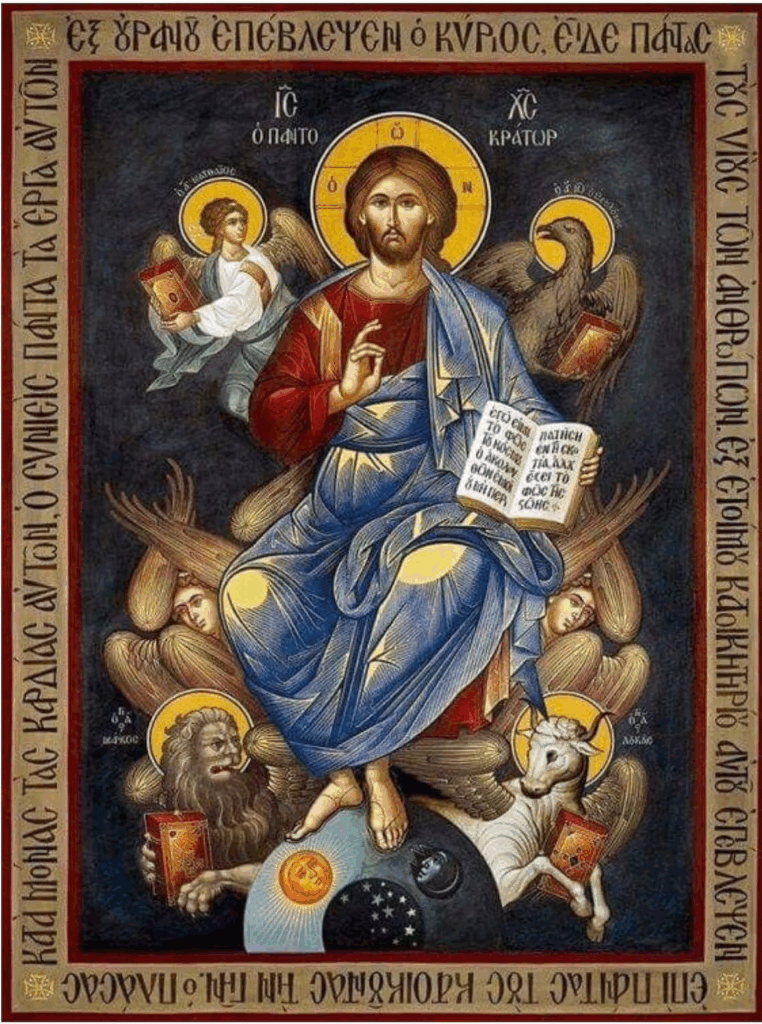
Now the Lord descended in the cloud and stood with him there, and proclaimed the Name of the Lord.
Exodus 34:5
A name, in biblical usage, reveals some of the mystery of the person, plant or object.
Out of the ground the Lord God formed every beast of the field and every bird of the air, and brought them to Adam to see what he would call them. And whatever Adam called each living creature, that was its name.
Genesis 2:19
This is not a mere coincidence, Adam makes a word out of nothing and then applies it to each animal, but the name relates to what it is. We see this when our father Abram was given a new name.
No longer shall your name be called Abram, but your name shall be Abraham; for I have made you a father of many nations.
Genesis 17:5
The name Abraham means ‘father of a multitude,’ the name reveals who this person is. So, when Moses stands on Mount Sinai and the Lord proclaims His Name, He is proclaiming Who He is: the Lord Almighty, the One Who is, the One Who causes all to exist. Immediately,
And the Lord passed before him and proclaimed, ‘The Lord, the Lord God, merciful and gracious, longsuffering, and abounding in goodness and truth,
Exodus 34:6–7
keeping mercy for thousands, forgiving iniquity and transgression and sin, by no means clearing the guilty, visiting the iniquity of the fathers upon the children and the children’s children to the third and the fourth generation.’
For indeed the Lord is merciful, abounding in mercy, and gives generously, the Lord accepts repentant sinners and the Lord exacts vengeance on the unrighteous. These three need to be held together, these three reveal God to us, and when one or two are stressed at the expense of the third we have a wrong view of God.
God is generous towards us and has given us all we have—the air we breathe, the clothes we wear, the food we eat, the homes in which we live, our assets, our wealth, our education, our everything: all are from Him. God receives us whenever and wherever we repent from our sins, but the key is that we repent rather than justify, we accept rather than explain, we admit rather than blame. Yet God, too, honours our freedom and from our sins for which we do not repent we face the consequences, and the consequences can have an effect on my children and their children even to the fourth generation: it is not that children are guilty for what their great-grandfather did but that they may bear the bad effects of his sin.
We see this all combined in the account given in Scripture of the Last Judgement.
When the Son of Man comes in His glory, and all the holy angels with Him, then He will sit on the Throne of His Glory.
Matthew 25:31–36, 41–43
All the nations will be gathered before Him, and He will separate them one from another, as a shepherd divides his sheep from the goats.
And He will set the sheep on His right hand, but the goats on the left.
Then the King will say to those on His right hand, ‘Come, you blessed of My Father, inherit the Kingdom prepared for you from the foundation of the world:
for I was hungry and you gave Me food; I was thirsty and you gave Me drink; I was a stranger and you took Me in;
I was naked and you clothed Me; I was sick and you visited Me; I was in prison and you came to Me.’ …
Then He will also say to those on the left hand, ‘Depart from Me, you cursed, into the everlasting fire prepared for the devil and his angels:
for I was hungry and you gave Me no food; I was thirsty and you gave Me no drink;
I was a stranger and you did not take Me in, naked and you did not clothe Me, sick and in prison and you did not visit Me.
For indeed the Lord is generous, giving the Kingdom as well as the food, the drink, the home, the clothing, the opportunity to visit, the Lord is forgiving because their acts of generosity are outward signs of their repentance and the Lord brings justice upon those who sin but do not repent.
My dear brothers and sisters in Christ, let us hold within us all three of these aspects of God, not solely holding onto the ones which conform to our opinions, so that we may more faithfully be joined to Christ, “Who is and Who was and Who is to come, the Almighty,” (Revelation 1:8) and His Resurrection, that we might repent more fully of our sins and that we may be received as heirs into His Kingdom.
Come and see!
We serve a meal following the Liturgy on Sundays. All are welcome.
Do you, or someone you know, want to join our mailing list and receive our weekly email? Then let me know.
Sermon
In the name of the Father, and of the Son, and of the Holy Spirit, one God, Amen.
Look around you: even this modern society where many seem to believe—hubristically—we are at the pinnacle of human progress, where we can cure more diseases than ever, where we can support people with chronic illnesses to lead a near normal life, where food can be delivered around the world and communication from one side of the planet to the other can be virtually instantaneous, where we in western Europe have experienced unprecedented decades of peace: despite all this the utopia promised has failed to materialise. There is still suffering, there is still pain, there is still death; and while some may be able to delay these further into the future than ever before, though this is much more the preserve of the rich rather than the poor, life in this world comes to a crashing end.
And into this world of suffering and death, Christ comes. God desires to rescue mankind from out of the Pit of Destruction, from out of Hades. But I ate from the tree, I brought death into this world, and the Lord has already told me,
“Of every tree of the garden you may freely eat;
but of the tree of the knowledge of good and evil you shall not eat, for in the day that you eat of it you shall surely die.”
— Genesis 2:16–17
I have eaten and therefore I must die: but Christ comes and challenges all, vies with all, attacks all. I want Christ to abolish pain and suffering—much more for my own benefit than for others, though I do not suffer nearly as much as many do—I want their abolition, Christ transforms them. Christ comes into this world and says to me, “You’ve ruined everything! But this is what I have to work with so this is how I will proceed.” The Lord does not undo pain, suffering and dying, He transforms them, He makes them new.
…
Read this Sermon, Carry our crosses.
Archive of Past Sermons.
Services this week
Friday 26th September
Discussion on the Prophecy of Isaiah, 8 pm
Online only
Saturday 27th September
Great Vespers, 6.30 pm
At 3rd URC Scout Hall, Chandlers Ford
Sunday 28th September
Matins & Divine Liturgy, 9 am
At 3rd URC Scout Hall, Chandlers Ford
Online session is via Google Meet: please get indd contact for the details.
Please join us: all are welcome, come and see.
Attending Church
We meet at 3rd URC Scout HQ, Kings Rd, Chandlers Ford SO53 2EY. The Scout hall is behind and to the left of the URC Church. Come and See.
Can I help you?
I am here for you, you need only ask. Is there a way I can support your life of faith? Get in touch.
Can you help the parish?
Yes, absolutely. Offer yourselves to the Lord: pray! Make available to him all your talents and ask him how he would like you to use them — listen for his reply.
Your prayers!
With love in Christ
Fr Alexander
webenquiry@orthodoxeastleigh.uk