
In the name of the Father, and of the Son, and of the Holy Spirit, one God, Amen.
Christ is risen!
One of the great blessings we have in our society is the willingness of many—whether Christian or otherwise—to give to, and to raise money for, the suffering. Whether in this country or abroad, our nation helps and supports those in need. And while there is always more that could be done, this attitude is to be commended. We see on advertisements, we hear on the streets and among friends, calls to raise money for those who are in need of help and support.
Yet this is not absolute. Causes for which we see children suffering, the innocent affected and the undeserving mistreated stand at the forefront of our attempts to appear compassionate. For former prisoners struggling on release, for addicts trying to get clean, for gamblers who have lost everything, for these and more we might be less inclined to help and support. If the public perceive the beneficiaries of charity as being at least in part to blame for their misfortunes, those charities often struggle for support. “You’re getting the results of your own stupidity,” we sneer from our ivory towers, “you might get help but only once we’ve supported the more deserving.”
And when I see someone suffering, before anything else, I think to myself, “who sinned, this man or someone else, that he suffers like this?” And if someone else then he might deserve my help whereas if it is he himself then I probably will hold back. I am the arbiter, I am the judge, I am the one who will ascribe blame; I think of myself as in charge of my life, the one who can stand above the everyday—judging motives and arbitrating over dissent—while all others may witness my own magnificence. Given every advantage I fail to see my own sin and my own iniquities, and despite many benefits in my life I fail to see in others ones who need to be served and honoured.
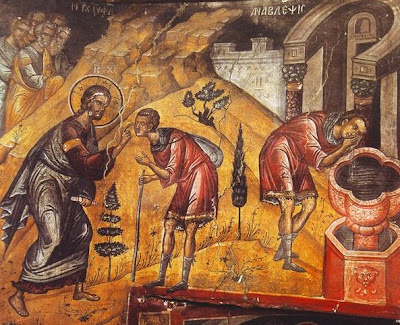
And the Lord stands before each one of you, spits on the ground and smears the clay He makes from it into your eye sockets. This is not a pleasant experience, this is not less disgusting because it is in the words of the Gospel: you are degraded and humiliated. Yet God continues to expect more of you: you might want to hide your shame and cover your indignity, He says to you, “Go, wash in the pool of Siloam.” He does not want in you a healing where you can just thank your lucky stars and then carry on with your lives, He wants you to act that His Kingdom may be glorified.
Yet seeing you with your sight, ready to glorify God, I remain unmoved. “This man is not from God,” I proclaim when hearing your story, “for He does not keep the Sabbath.” And God is calling on each of you to proclaim the Gospel—a daunting task, feeling like an impossible task. It is given that you must answer, yet not that you must answer alone. “But sanctify the Lord God in your hearts,” says the Apostle Peter,
and always be ready to give a defence to everyone who asks you a reason for the hope that is in you, with meekness and fear;
First Peter 3:15–17
having a good conscience, that when they defame you as evildoers, those who revile your good conduct in Christ may be ashamed.
For it is better, if it is the will of God, to suffer for doing good than for doing evil.
And your words, when spoken without malice and triumphalism, will proclaim the Gospel of Christ with greater strength than my incredulity and dismissal.
Whether he is a sinner, I do not know; one thing I know, that though I was blind, now I see.
My dear brothers and sisters in Christ, we draw close to the end of this paschal season, and our world wishes to dismiss it as a story, a myth, which attempts to bring false comfort to the gullible, the less intelligent. The demons’ objection is not outright but subtle,
If it gives you comfort, that’s great: but there’s no way it can be real, there’s no way it can be true. It’s just a nice story.
But the account, the testimony, of the man born blind is our witness of its Truth. The Resurrection cannot be merely a story about the beginning of Christianity, it is either the Truth or a fiction, either the only Way to see reality or a deception. The Church proclaims the truth of the defeat of death, sin and idolatry and the invitation to new Life. And to participate in this we, each one of us, are called to deny our sin and repent, to live as dead to the world that we may be alive in Christ. And if we do this, if we remain loyal and faithful to the Resurrection which continues to have eternal meaning even in this world of sin, then,
Who shall separate us from the love of Christ? Shall tribulation, or distress, or persecution, or famine, or nakedness, or peril, or sword?
Romans 8:35–39
As it is written:
‘For Your sake we are killed all day long;
We are accounted as sheep for the slaughter.’
Yet in all these things we are more than conquerors through Him who loved us.
For I am persuaded that neither death nor life, nor angels nor principalities nor powers, nor things present nor things to come,
nor height nor depth, nor any other created thing, shall be able to separate us from the love of God which is in Christ Jesus our Lord.
My dear brothers and sisters in Christ, this close of Pascha is not its end, it is an invitation to receive all the love of God, to make it our own, as we continue our sojourn in this world. Let us accept this invitation, let us turn in repentance to the Lord Who will receive us with open arms, let us end for this year the saying of “Christ is risen!” not because it is forgotten in our lives but that it resonates and echoes in our hearts. And, until that moment arrives, let us proclaim with our whole hearts and our whole minds the source of the hope that is within us,
Christ is risen from the dead
Trampling down death by death
And upon those in the tombs
Bestowing Life!
Christ is risen! He is risen indeed!
That we may proclaim the Truth of the Resurrection of our Lord and Saviour Jesus Christ and come to worship Him ever more fully, together with His unoriginate Father and the All-holy, Good and Life-creating Spirit. Amen.
In those days, as we apostles were going to the place of prayer, we were met by a slave girl who had a spirit of divination and brought her owners much gain by soothsaying. She followed Paul and us, crying, “These men are servants of the Most High God, who proclaim to you the way of salvation.” And this she did for many days. But Paul was annoyed, and turned and said to the spirit, “I charge you in the name of Jesus Christ to come out of her.” And it came out that very hour. But when her owners saw that their hope of gain was gone, they seized Paul and Silas and dragged them into the market place before the rulers; and when they had brought them to the magistrates they said, “These men are Jews and they are disturbing our city. They advocate customs which it is not lawful for us Romans to accept or practice.” The crowd joined in attacking them; and the magistrates tore the garments off them and gave orders to beat them with rods. And when they had inflicted many blows upon them, they threw them into prison, charging the jailer to keep them safely. Having received this charge, he put them into the inner prison and fastened their feet in the stocks. But about midnight Paul and Silas were praying and singing hymns to God, and the prisoners were listening to them, and suddenly there was a great earthquake, so that the foundations of the prison were shaken; and immediately all the doors were opened and every one’s fetters were unfastened. When the jailer woke and saw that the prison doors were open, he drew his sword and was about to kill himself, supposing that the prisoners had escaped. But Paul cried with a loud voice, “Do not harm yourself, for we are all here.” And he called for lights and rushed in, and trembling with fear he fell down before Paul and Silas, and brought them out and said, “Men, what must I do to be saved?” And they said, “Believe in the Lord Jesus, and you will be saved, you and your household.” And they spoke the word of the Lord to him and to all that were in his house. And he took them the same hour of the night, and washed their wounds, and he was baptized at once, with all his family. Then he brought them up into his house, and set food before them; and he rejoiced with all his household that he had believed in God.
— Acts 16:16–34
At that time, as Jesus passed by, he saw a man blind from his birth. And his disciples asked him, “Rabbi, who sinned, this man or his parents, that he was born blind?” Jesus answered, “It was not that this man sinned, or his parents, but that the works of God might be made manifest in him. We must work the works of him who sent me, while it is day; night comes, when no one can work. As long as I am in the world, I am the light of the world.” As he said this, he spat on the ground and made clay of the spittle and anointed the man’s eyes with the clay, saying to him, “Go, wash in the pool of Siloam” (which means Sent). So he went and washed and came back seeing. The neighbors and those who had seen him before as a beggar, said, “Is not this the man who used to sit and beg?” Some said, “It is he”; others said, “No, but he is like him.” He said, “I am the man.” They said to him, “Then how were your eyes opened?” He answered, “The man called Jesus made clay and anointed my eyes and said to me, ‘Go to Siloam and wash’; so I went and washed and received my sight.” They said to him, “Where is he?” He said, “I do not know. They brought to the Pharisees the man who had formerly been blind. Now it was a sabbath day when Jesus made the clay and opened his eyes. The Pharisees again asked him how he had received his sight. And he said to them, “He put clay on my eyes and I washed, and I see.” Some of the Pharisees said, “This man is not from God, for he does not keep the sabbath.” But others said, “How can a man who is a sinner do such signs?” There was a division among them. So they again said to the blind man, “What do you say about him, since he has opened your eyes?” He said, “He is a prophet. The Jews did not believe that he had been blind and had received his sight, until they called the parents of the man who had received his sight, and asked them, “Is this your son, who you say was born blind? How then does he now see?” His parents answered, “We know that this is our son, and that he was born blind; but how he now sees we do not know, nor do we know who opened his eyes. Ask him; he is of age, he will speak for himself.” His parents said this because they feared the Jews, for the Jews had already agreed that if anyone should confess him to be Christ he was to be put out of the synagogue. Therefore his parents said, “He is of age, ask him. So for the second time they called the man who had been blind, and said to him, “Give God the praise; we know that this man is a sinner.” He answered, “Whether he is a sinner, I do not know; one thing I know, that though I was blind, now I see.” They said to him, “What did he do to you? How did he open your eyes?” He answered them, “I have told you already and you would not listen. Why do you want to hear it again? Do you too want to become his disciples?” And they reviled him, saying, “You are his disciple, but we are disciples of Moses. We know that God has spoken to Moses, but as for this man, we do not know where he comes from.” The man answered, “Why, this is a marvel! You do not know where he comes from, and yet he opened my eyes. We know that God does not listen to sinners, but if anyone is a worshiper of God and does his will, God listens to him. Never since the world began has it been heard that anyone opened the eyes of a man born blind. If this man were not from God, he could do nothing.” They answered him, “You were born in utter sin, and would you teach us?” And they cast him out. Jesus heard that they had cast him out, and having found him he said, “Do you believe in the Son of man?” He answered, “And who is he, sir, that I may believe in him?” Jesus said to him, “You have seen him, and it is he who speaks to you.” He said, “Lord, I believe”; and he worshiped him.
— John 9:1–38