
In the name of the Father, and of the Son, and of the Holy Spirit, one God, Amen.
Christ is risen!
“Trust me,” someone says to me, and my trust will depend on who that person is. If a doctor I might trust on medical issues but not necessarily on an “investment opportunity,” if a mechanic I might trust on car maintenance but not necessarily on raising children well. If a friend, or an acquaintance, I might give more weight to his words but even then it may well have limits—I might trust a close family member about many things but how about if they encourage me to walk into a lion enclosure or jump from a bridge? Trust, then, depends on who the person is, my relationship with him, and what exactly am I being told to think or to do. Trust me.
The ten had seen the Lord risen from the dead so they said to Thomas, “We have seen the Lord.” But Thomas had been present when the women ran back from the empty tomb,
Then they returned from the tomb and told all these things to the eleven and to all the rest.
Luke 24:9–11
It was Mary Magdalene, Joanna, Mary the mother of James, and the other women with them, who told these things to the apostles.
And their words seemed to them like idle tales, and they did not believe them.
The Apostle Thomas was being consistent. He was present when the women offered words and, like the other disciples, rejected those words as “idle tales.” The ten, too, are offering words and he maintains his position. “Trust us,” they are saying to him,
that we have seen Him alive. Trust us that the One we saw brutally executed has defeated death. Trust us: though we hide cowering from the authorities we have seen Christ.
But Thomas is able to reason for himself. As a group the eleven dismissed the women’s words as “idle tales,” but being able to reason he says to them,
Unless I see in His hands the print of the nails, and place my finger in the mark of the nails, and place my hand in His side, I will not believe.
Which sounds negative to us English speakers because it is given in the negative. In the positive we could paraphrase it as,
If I see in His hands the print of the nails, and place my finger in the mark of the nails, and place my hand in His side, I will be faithful.
St Thomas is saying to the other disciples, “I want to trust you but I need evidence: show this to me and I will be faithful.”
And this is given to us also. We do not have the blessing to place our fingers in the mark of the nails, but we have two millennia of Church history, we have eye-witnesses of the risen Christ willing to suffer torture and execution rather than say it was a lie, we have transformed lives, we have divine revelations in the lives of the saints, in the life of the Church. We have those whom we believe that we can trust telling us the reality of the Resurrection. We have ourselves experienced change and transformation in Christ—yes, indeed, I am a work in progress, and there is much progress more necessary, but Christ pours out blessings on us. Our faith, our Christianity, is not wishful thinking for the naïve to understand better, our faithfulness is the appropriate response to the evidence before us.
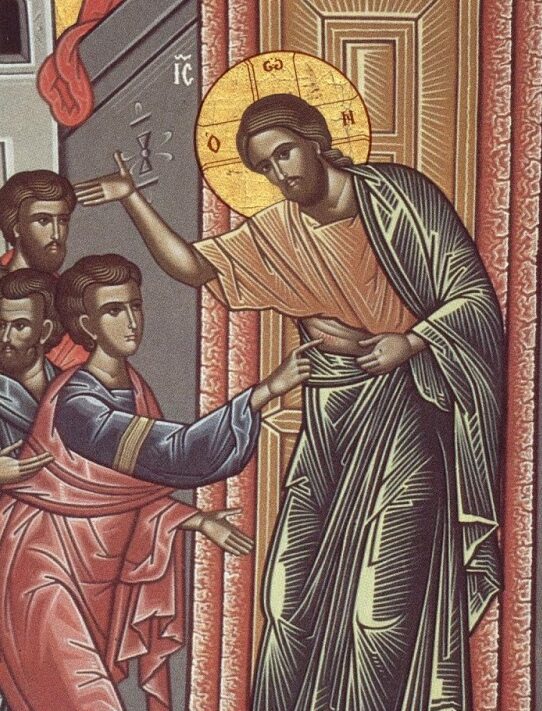
Eight days later, His disciples were again in the house, and Thomas was with them. The doors were shut, but Jesus came and stood among them and said, ‘Peace be with you.’ Then He said to Thomas, ‘Put your finger here, and see My hands; and put out your hand, and place it in My side; do not be faithless, but faithful.’
And presented with the evidence, the Apostle Thomas is blessed to say the true high-point of the Gospel. The entirety of John’s Gospel has been leading up to this point, for while we have seen and heard Christ referred to as God elsewhere—it is possible for some who would like to pervert the Gospel to say “this just means ‘divine,’ not ‘the Most High God,’”—Thomas proclaims Christ as ὁ θεός which can only be of the Most High, “Ὁ κύριός μου καὶ ὁ θεός μου.” (“My Lord and my God.”) And having made this highest of all proclamations on the identity of Christ, the Lord blesses him and blesses us.
Have you believed because you have seen Me? Blessed are those who have not seen and yet believe.
And then the beloved disciple, the Apostle John, concludes the whole purpose of all the Gospel accounts. As an old man nearing the end of his earthly life, writing to faithful, many of whom were not even born at the time of the events described, remembering these salvific events of his youth, he says to you and he says to me,
Now Jesus did many other signs in the presence of the disciples, which are not written in this book; but these are written that you may believe that Jesus is the Christ, the Son of God, and that believing, you may have Life in His name.
These are written not that we have an epic story to tell to our society, not that we have an origin myth, not that we want a competing narrative against paganism nor against certain interpretations of evolution, these are written that we may have Life. These are written that we may be free—free from slavery, but also free from tyranny, free from control, free even from being told what to think—here is the evidence, now you decide. Is this the Christ, the Son of the living God, Who came into the world to save sinners of whom I am the first or not?
My dear brothers and sisters in Christ, the Church is calling on us to trust Her: not a blind trust, an unquestioning trust nor a trust that refuses questions and dissent, but a trust based on the evidence, a trust based on love, a trust based on the question, “does this make the most perfect sense of the reality in which we live?” Here is the Gospel, here is the news that death’s hold over the human race has been annihilated, that sin’s grip over our fate has been irrevocably broken, that idolatry’s power has been forever defeated, because Christ is risen! Let us, therefore, maintain this unbroken chain of faithfulness to the Resurrection, that Christ be proclaimed here and throughout the world, that the Gospel of Love may be available to all the more and that we be true followers of our Lord and Saviour Who died so we might have Life in abundance and co-reign together with Him.
Christ is risen! He is risen indeed!
To our crucified and risen Saviour, Jesus Christ, be all glory, honour and worship, together with His unoriginate Father and the All-holy, Good and Life-giving Spirit. Amen.
In those days, many signs and wonders were done among the people by the hands of the apostles. And they were all together in Solomon’s Portico. None of the rest dared join them, but the people held them in high honor. And more than ever believers were added to the Lord, multitudes both of men and women, so that they even carried out the sick into the streets, and laid them on beds and pallets, that as Peter came by at least his shadow might fall on some of them. The people also gathered from the towns around Jerusalem, bringing the sick and those afflicted with unclean spirits, and they were all healed. But the high priest rose up and all who were with him, that is, the party of the Sadducees, and filled with jealousy they arrested the apostles and put them in the common prison. But at night an angel of the Lord opened the prison doors and brought them out and said, “Go and stand in the temple and speak to the people all the words of this Life.”
— Acts 5:12–20
On the evening of that day, the first day of the week, the doors being shut where the disciples were for fear of the Jews, Jesus came and stood among them and said to them, “Peace be with you.” When He had said this, He showed them His hands and His side. Then the disciples were glad when they saw the Lord. Jesus said to them again, “Peace be with you. As the Father has sent Me, even so I send you.” And when He had said this, He breathed on them and said to them, “Receive the Holy Spirit. If you forgive the sins of any, they are forgiven; if you retain the sins of any, they are retained.” Now Thomas, one of the twelve, called the Twin, was not with them when Jesus came. So the other disciples told him, “We have seen the Lord.” But he said to them, “Unless I see in His hands the print of the nails, and place my finger in the mark of the nails, and place my hand in His side, I will not believe.” Eight days later, His disciples were again in the house, and Thomas was with them. The doors were shut, but Jesus came and stood among them and said, “Peace be with you.” Then He said to Thomas, “Put your finger here, and see My hands; and put out your hand, and place it in My side; do not be faithless, but believing.” Thomas answered Him, “My Lord and My God!” Jesus said to him, “Have you believed because you have seen Me? Blessed are those who have not seen and yet believe.” Now Jesus did many other signs in the presence of the disciples, which are not written in this book; but these are written that you may believe that Jesus is the Christ, the Son of God, and that believing, you may have life in His name.
— John 20:19–31