
In the name of the Father, and of the Son, and of the Holy Spirit, one God, Amen.
“Let us find, dear brothers and sisters, a more efficient way of glorifying God, a way less costly,” we are tempted to say, “a way which can achieve what we have currently but with our limited budget in mind.” And this makes sense. We do not have infinite resources; we are a small community with a modest budget and cannot burn through money if we want a future. “We could divert resources into other projects which will benefit our Church.”
The Lord speaks directly to this mindset. When I think like this, I am saying to Christ, “Why was this not sold for three hundred denarii and given to the poor?” And He replies to me in the manner in which I deserve,
Let her alone, let her keep it for the day of my burial. The poor you always have with you, but you do not always have me.
Worship of the living God was never meant to be cheap. Offering a sheep or a cow in burnt offering is not cheap, the Tabernacle and all the furnishing were not bargains, the Temple not economical. And likewise it is not low-budget in the New Covenant: it requires of us, not only money but effort too, not only attendance but participation in prayer. You and I, each one of us, are called to offer the best we have for the glory of God, not simply the least with which we can get away. If the best we can offer is two mites, two small coins, (see Mark 12:41–44, Luke 21:1–4) then this is to the glory of God and our salvation, but this does not justify giving just two coins when we are able to give more.
For what we are to demonstrate is our generosity towards God. A parent who gives a new car to one son and a notepad to the other is, in a sense, being generous towards both but we feel the hypocrisy and bias, likewise one who buys luxuries in one portion of his life but is stingy towards God demonstrates with his generosity, or lack thereof, where his true priorities lie. It is not that God needs our gifts for Him but that through our giving we demonstrate what we place first in our lives, God or mammon. (see Matthew 6:24)
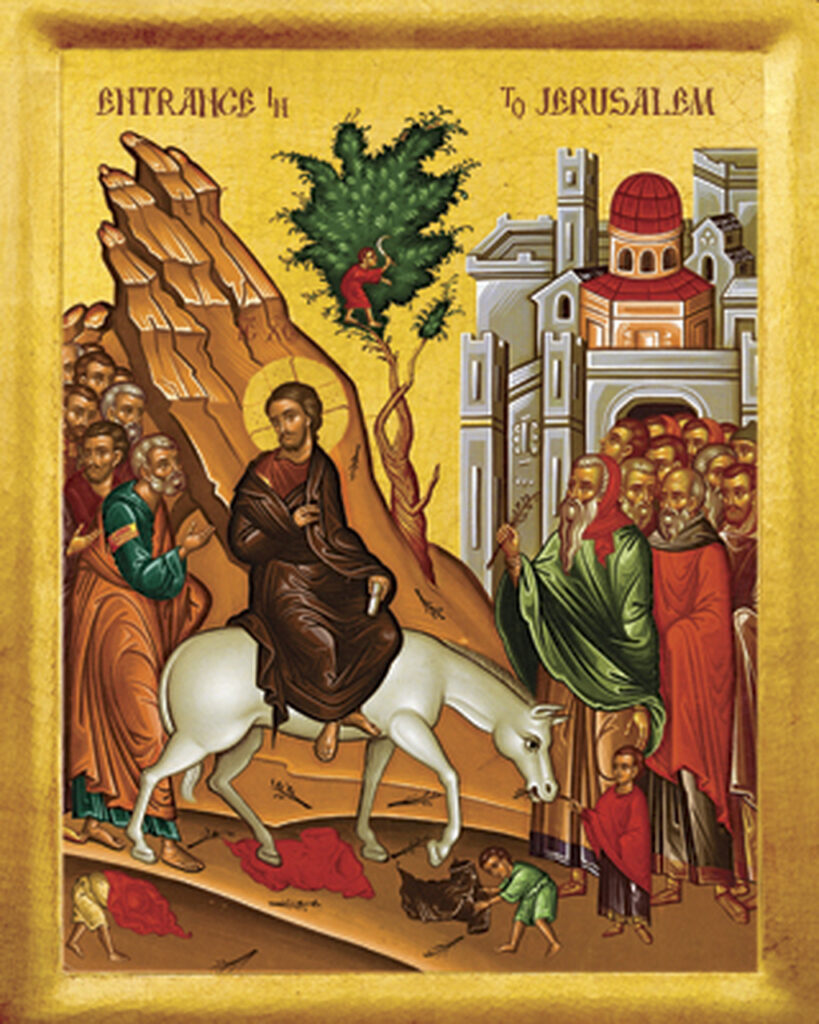
Indeed, today God journeys to the Holy City, we cannot sit on the fence, we must choose which way we shall go. Will we stay with Him only in the good times—with fanfare and cheering, with triumphant entries as the King Who conquers with Peace—but then fade away when life turns hard? Or will we stay with Him when He is arrested, will we stay with Him when He is jeered by the crowd, will we stay with Him at Golgotha and the Cross?
My dear brothers and sisters in Christ, what we offer towards Christ—our time, our talents, our energy, our money—demonstrates more perfectly than our words where He stands in our priorities. Let us place Christ first in our lives, offering to Him as much as we can, and then a little bit more, that we may be worthy to bear our crosses alongside His, that we may be lifted up at Golgotha alongside Him, that we may die to all that is perishing and rise to new Life with Him. Let us not be solely Christians with our lips but Christians with our deeds and our actions that we may join the Victory over sin, death and idolatry and inherit eternal Life.
That we may offer our all to our Lord and Saviour Jesus Christ, in Whose triumphant Entry into Jerusalem we now participate, together with His unoriginate Father and the All-holy, Good and Life-giving Spirit. Amen.
Brethren, rejoice in the Lord always; again I will say, Rejoice. Let all men know your forbearance. The Lord is at hand. Have no anxiety about anything, but in everything by prayer and supplication with thanksgiving let your requests be made known to God. And the peace of God, which passes all understanding, will keep your hearts and your minds in Christ Jesus. Finally, brethren, whatever is true, whatever is honorable, whatever is just, whatever is pure, whatever is lovely, whatever is gracious, if there is any excellence, if there is anything worthy of praise, think about these things. What you have learned and received and heard and seen in me, do; and the God of peace will be with you.
— Philippians 4:4–9
Six days before Passover, Jesus came to Bethany, where Lazaros was, whom Jesus had raised from the dead. There they made him a supper; Martha served, and Lazaros was one of those at table with him. Mary took a pound of costly ointment of pure nard and anointed the feet of Jesus and wiped his feet with her hair; and the house was filled with the fragrance of the ointment. But Judas Iscariot, one of his disciples (he who was to betray him), said “Why was this ointment not sold for three hundred denarii and given to the poor?” This he said, not that he cared for the poor but because he was a thief, and as he had the money box he used to take what was put into it. Jesus said, “Let her alone, let her keep it for the day of my burial. The poor you always have with you, but you do not always have me.” When the great crowd of the Jews learned that he was there, they came, not only on account of Jesus but also to see Lazaros, whom he had raised from the dead. So the chief priests planned to put Lazaros also to death, because on account of him many of the Jews were going away and believing in Jesus. The next day a great crowd who had come to the feast heard that Jesus was coming to Jerusalem. So they took branches of palm trees and went out to meet him, crying, “Hosanna! Blessed is he who comes in the name of the Lord, even the King of Israel!” And Jesus found a young donkey and sat upon it; as it is written, “Fear not, daughter of Zion; behold, your king is coming, sitting on a donkey’s colt!” His disciples did not understand this at first; but when Jesus was glorified, then they remembered that this had been written of him and had been done to him. The crowd that had been with him when he called Lazaros out of the tomb and raised him from the dead bore witness. The reason why the crowd went to meet him was that they heard he had done this sign.
— John 12:1–18