
In the name of the Father, and of the Son, and of the Holy Spirit, one God, Amen.
In the passages leading up to today’s Gospel reading, we have Peter’s response to the question, “Who do men say that I am?” (Mark 8:27–30) Christ telling His disciples that He must be executed and will rise in three days, (8:31–33) the call to take up our crosses (8:34–9:1) and the Transfiguration. (9:2–13) These four consecutive events form a critical moment in the Synoptic Gospels—which is to say Matthew, Mark and Luke—the early portion of the narrative has Christ centred in Galilee as a wandering preacher, healer and prophet, now eyes are set towards Jerusalem further south and the defeat of the Satan and his powers at the new Pascha, the new Passover, from death to Life.
And at this transitional moment, at this shift in tone, direction and purpose, a man steps forward wanting to continue the ministry in Galilee. Christ had shown His power already as the Son of God by healing, by casting out demons, by performing miracles. Yet this father—in a very human way, in a way full of love and compassion for his son—yearns for one more.
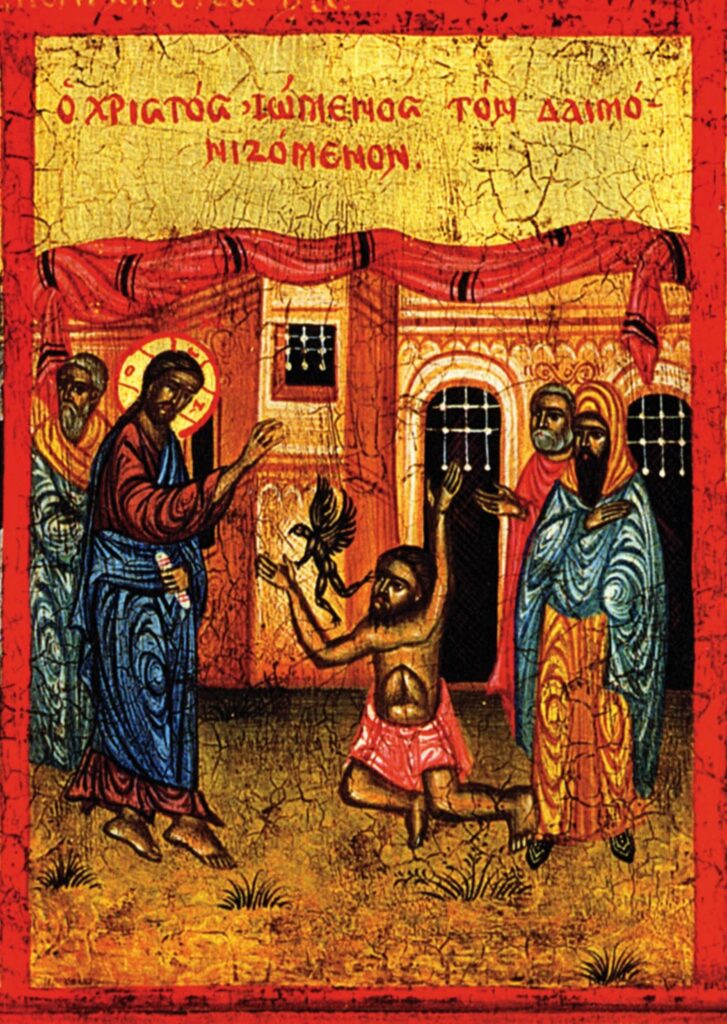
And I do the same. Christ has performed many mighty works, many miracles, so that we may know the Truth of Who He is. I have had so many blessings in my life yet I still try to bargain with Him, to coerce Him into following my requests and demands. “Perform this miracle for me, O Lord,” I cry out to Him in prayer, “and I will be a good Christian, a true Christian, I will give to the Church, I will help the poor, I will forgive my neighbour.” Because my Christian life is conditional: so long as I get what I want I will deign to make a semblance of Christianity, as soon as the blessings and miracles stop then so will I.
And Christ speaks to me. He does not speak so much to the father in the narrative, for at least he is acting for the sake of his son and not directly his own: the Lord looks upon me with love and compassion and says,
O faithless generation, how long am I to be with you? How long am I to bear with you?
And the words spoken by the Lord to those desiring to be filled with the food which perishes apply to me.
Most assuredly, I say to you, you seek Me, not because you saw the signs, but because you ate of the loaves and were filled.
John 6:26–27
Do not labour for the food which perishes, but for the food which endures to everlasting Life, which the Son of Man will give you, because God the Father has set His seal on Him.
And yet even in this state, focused on His journey to Jerusalem and to the new Exodus, Christ performs the miracle. The father speaks the words that so resonate with our generation, “I believe; help my unbelief!” and the boy is healed. My own prayer, too, is heard by the Lord and He responds to me. It may not be in the way I want or desire, it may not be that I even hear His response because I have failed to quieten my own heart, but He responds and blesses me. But now I become responsible for this blessing I have received, I become answerable for what the Lord has done for me. It is now added to the list of blessings I have received and Christ, on the Last Day, will require an account: “What did you do with the many talents you have received?” Will I bring forth more talents in return, or will I say,
Lord, I knew you to be a hard man, reaping where you have not sown, and gathering where you have not scattered seed.
Matthew 25:24–25
And I was afraid, and went and hid your talent in the ground. Look, there you have what is yours.
My dear brothers and sisters in Christ, even when we come at inopportune times the Lord will deign to listen to our prayers and answer them with blessings. And sometimes the blessings are miracles and sometimes an apparent lack of miracles. But these blessings, these talents, are given to us that we may bless others, that we may feed the hungry and give drink to the thirsty, that we take in the stranger, clothe the naked and visit the sick and imprisoned. (see Matthew 25:31–46) Let us, therefore, quieten our hearts to hear the Lord’s reply and let us bless others as He has already blessed us, not as a condition of our faith but as a consequence of our faithfulness. Let us repent of our desire for God to serve us and be His servants in the world, bringing the Gospel—the news of the defeat of all which oppresses us—to as many as would receive Him and believe in His name. (see John 1:12)
That we may offer true praise, glory and worship to our God and Saviour Jesus Christ, Who hears our prayers and offers us a multitude of blessings, together with His unoriginate Father and the All-holy, Good and Life-giving Spirit. Amen.
Brethren, when God made a promise to Abraham, since he had no one greater by whom to swear, he swore to himself, saying, “Surely I will bless you and multiply you.” And thus Abraham, having patiently endured, obtained the promise. Men indeed swear by a greater than themselves, and in all their disputes an oath is final for confirmation. So when God desired to show more convincingly to the heirs of the promise the unchangeable character of his purpose, he interposed with an oath, so that through two unchangeable things, in which it is impossible that God should prove false, we who have fled for refuge might have strong encouragement to seize the hope set before us. We have this as a sure and steadfast anchor of the soul, a hope that enters into the inner shrine behind the curtain, where Jesus has gone as a forerunner on our behalf, having become a high priest for ever after the order of Melchizedek.
— Hebrews 6:13–20
At that time, a man came to Jesus kneeling and saying: “Teacher, I brought my son to you, for he has a dumb spirit; and wherever it seizes him it dashes him down; and he foams and grinds his teeth and becomes rigid; and I asked your disciples to cast it out, and they were not able.” And he answered them, “O faithless generation, how long am I to be with you? How long am I to bear with you? Bring him to me.” And they brought the boy to him; and when the spirit saw him, immediately it convulsed the boy, and he fell on the ground and rolled about, foaming at the mouth. And Jesus asked his father, “How long has he had this?” And he said, “From childhood. And it has often cast him into the fire and into the water, to destroy him; but if you can do anything, have pity on us and help us.” And Jesus said to him, “If you can! All things are possible to him who believes.” Immediately the father of the child cried out and said, “I believe; help my unbelief!” And when Jesus saw that a crowd came running together, he rebuked the unclean spirit, saying to it, “You dumb and deaf spirit, I command you, come out of him, and never enter him again.” And after crying out and convulsing him terribly, it came out, and the boy was like a corpse; so that most of them said, “He is dead.” But Jesus took him by the hand and lifted him up, and he arose. And when he had entered the house, his disciples asked him privately, “Why could we not cast it out?” And he said to them, “This kind cannot be driven out by anything but prayer and fasting.” They went on from there and passed through Galilee. And he would not have any one know it; for he was teaching his disciples, saying to them, “The Son of man will be delivered into the hands of men, and they will kill him; and when he is killed, after three days he will rise.
— Mark 9:17–31