
In the name of the Father, and of the Son, and of the Holy Spirit, one God, Amen.
“I must prove the truth of Christianity,” I proclaim in my heart, “I must demonstrate how others are wrong.” And I go about dismantling the arguments of others, proving their failures, ridiculing their errors. “I am fighting for Christ,” I lie to myself, “I am doing God’s works.”
The beloved disciple tells us,
If someone says, ‘I love God,’ and hates his brother, he is a liar; for he who does not love his brother whom he has seen, how can he love God whom he has not seen?
First John 4:20–21
And this commandment we have from Him: that he who loves God must love his brother also.
When I speak in these adversarial terms with my brother—yes indeed, my brother, for in Christ we are to see all as our neighbours, all as our brothers and sisters—I am lacking in love because my zeal is sourced in my own correctness rather than in God Who is Himself love. (First John 4:8, 16) And my love must not be centred in emotions, in having ‘loving feelings’ about my brother, but in service, in honour, in my own humility. I serve my brother whom I can see and thereby serve God Whom I do not see. Placing myself below God is an easy thing to do, it is just the natural order of existence, but placing myself below others is hard and shows a true dedication to God.
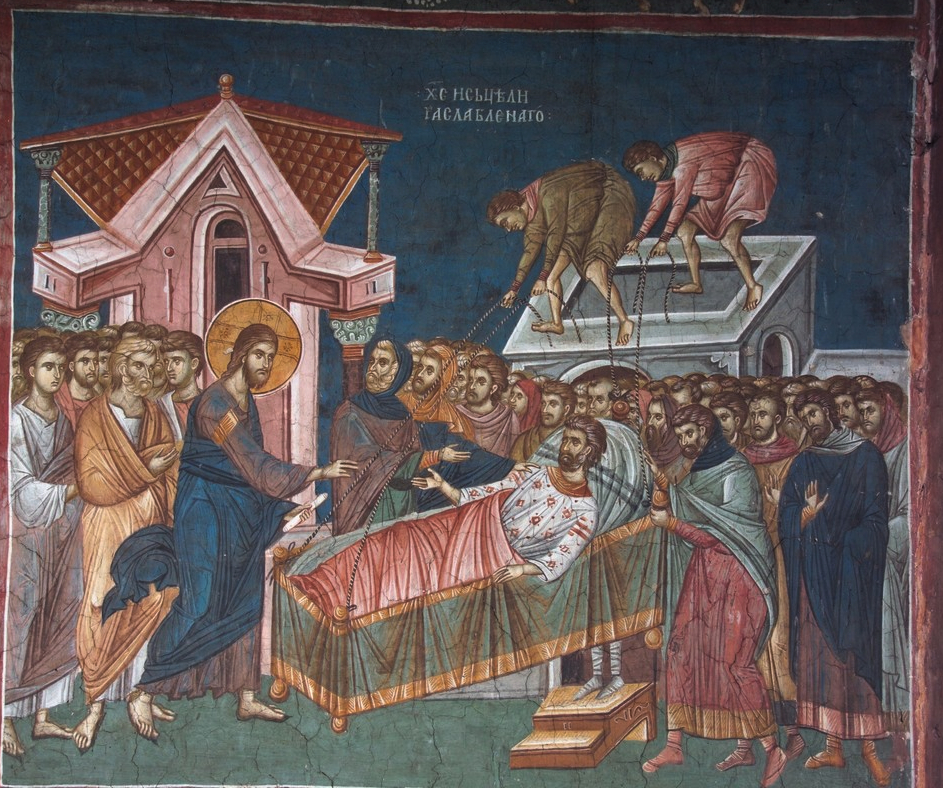
Christ is our Witness in this, yet He demonstrates this through an inversion. He does what is hard first, though it appears to us easy, and then confirms it by doing what is easy though appears hard. “My son,” says the Lord, “your sins are forgiven.” And we must not overlook the magnitude of this statement. This paralytic was, like all of us, a sinner: those who are sick, or in need, are not more righteous than others. Yet He saw the faith, the determination, of the four who bore him, who expressed their love for him in a tangible way, and removed his sins. This is the greatest miracle in today’s Gospel reading. And to confirm He has the right, the power and the authority to forgive sins He says, “rise, take up your pallet and go home.” What was unseen was confirmed by what was seen.
My dear brothers and sisters in Christ, we are the paralytic—we are sick and in need of the Father’s love. But we can be borne by the four Gospels to Christ. And what overshadows us, what separates us from seeing the heavens, the roof of our souls, will be removed by those four Gospels that we may be brought to our Saviour Who heals us of our sins. And while we may await physical healing in this life, we gain access to the heavens through our proximity to God. Let us, therefore, rejoice in the Lord and rejoice not in our correctness but in our service for others that we may demonstrate our faithfulness not through our easy words but our hard deeds and thereby express our love for God through our love for our neighbour. Let us witness not the Gospel, not the Church, but witness Christ to our world that we may be truly Christian and inheritors of eternal Life.
That we may offer true praise, glory and worship to our Lord and Saviour Jesus Christ, together with His unoriginate Father and the All-holy, Good and Life-giving Spirit. Amen.
In the beginning, Thou, Lord, didst found the earth in the beginning, and the heavens are the work of thy hands; they will perish, but thou remainest; they will all grow old like a garment, like a mantle thou wilt roll them up, and they will be changed. But thou art the same, and thy years will never end.” But to what angel has he ever said, “Sit at my right hand, till I make thy enemies a stool for thy feet?” Are they not all ministering spirits sent forth to serve, for the sake of those who are to obtain salvation? Therefore we must pay closer attention to what we have heard, lest we drift away from it. For if the message declared by angels was valid and every transgression or disobedience received a just retribution, how shall we escape if we neglect such a great salvation? It was declared at first by the Lord, and it was attested to us by those who heard him.
— Hebrews 1:10–14, 2:1–3
At that time, Jesus entered Capernaum and it was reported that he was at home. And many were gathered together, so that there was no longer room for them, not even about the door; and he was preaching the word to them. And they came, bringing to him a paralytic carried by four men. And when they could not get near him because of the crowd, they removed the roof above him; and when they had made an opening, they let down the pallet on which the paralytic lay. And when Jesus saw their faith, he said to the paralytic, “My son, your sins are forgiven.” Now some of the scribes were sitting there, questioning in their hearts, “Why does this man speak thus? It is a blasphemy! Who can forgive sins but God alone?” And immediately Jesus, perceiving in his spirit that they thus questioned within themselves, said to them, “Why do you question thus in your hearts? Which is easier, to say to the paralytic, ‘Your sins are forgiven, ‘ or to say, ‘Rise, take up your pallet and walk? But that you may know that the Son of man has authority on earth to forgive sins”-he said to the paralytic-“I say to you, rise, take up your pallet and go home.” And he rose, and immediately took up the pallet and went out before them all; so that they were all amazed and glorified God, saying, “We never saw anything like this!
— Mark 2:1–12