In the name of the Father, and of the Son, and of the Holy Spirit, one God, Amen.
The Gospel is for us the explosion of joy into the world. At its beginning and at its end, joy is proclaimed. “Do not be afraid,” says the angel to the shepherds,
for behold, I bring you good tidings of great joy which will be to all people.
Luke 2:10–11
For there is born to you this day in the city of David a Saviour, Who is Christ the Lord.
And at its conclusion the Apostles,
worshipped Him, and returned to Jerusalem with great joy,
Luke 24:52–53
and were continually in the temple praising and blessing God. Amen.
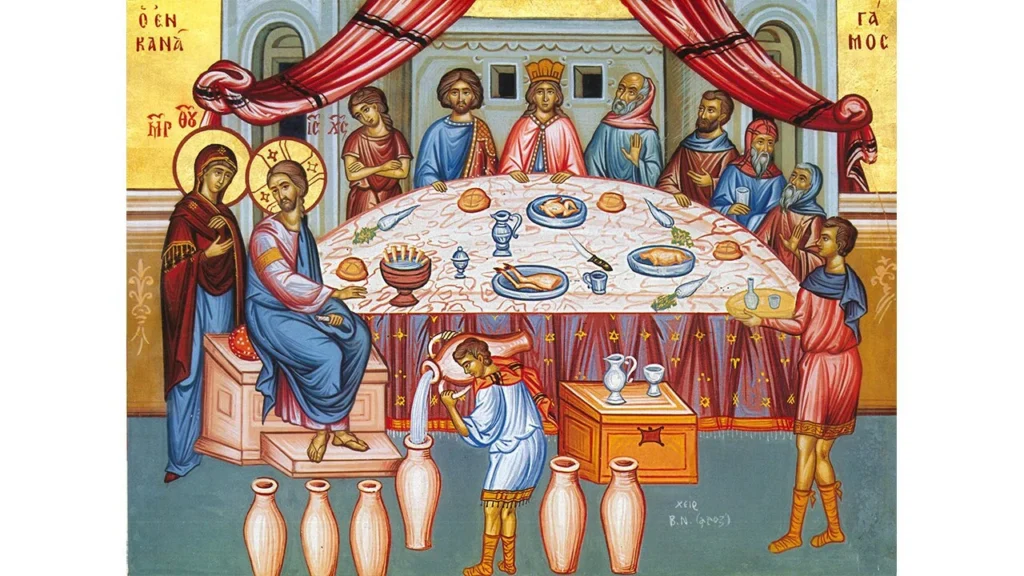
Yes, indeed, ours is a Faith of joy, of wonder, of glory to the living God. Christ has nullified idolatry, removed the power of sin which held us unjustly and defeated even death. And our response must be of joy, of gratitude, of thanksgiving. “This is the day the Lord has made,” cries out the Psalmist, “Let us greatly rejoice and be glad therein.” (Psalm 117:24 ʟxx)
===
The world says, “You are what you eat.” And in this statement, it seems, the world is trying to say, “there is nothing beyond your physical reality, all you are is just the processing of food and drink into bone and flesh; you are what you eat.” Fr Alexander Schmemann of blessed memory addressed this and tells us, in contrast, this phrase expresses,
the most religious idea of man. For long before … the same definition of man was given by the Bible. In the biblical story of creation man is presented, first of all, as a hungry being, and the whole world as his food. Second only to the direction to propagate and have dominion over the earth, according to the author of the first chapter of Genesis, is God’s instruction to men to eat of the earth: ‘Behold I have given you every herb bearing seed … and every tree, which is the fruit of a tree yielding seed; to you it shall be for food. …’ Man must eat in order to live; he must take the world into his body and transform it into himself, into flesh and blood. He is indeed that which he eats, and the whole world is presented as one all-embracing banquet table for man. And this image of the banquet remains, throughout the whole Bible, the central image of life. It is the image of life at its creation and also the image of life at its end and fulfilment: ‘… that you eat and drink at my table in my Kingdom.’
Fr Alexander Schmemann, ‘For the Life of the World,’ p. 11
===
Today, Christ calls us to this Banquet.
A man once gave a great Banquet, and invited many; and at the time of the Banquet he sent his servant to say to those who had been invited, ‘Come; for all is now ready.’
And this Banquet, this Liturgy, is the manifestation of joy in the world, for in it we are invited to become what we eat, to become divine. Christ deigns to offer to us Himself as food, not simply the manna from Heaven but the Bread of Life.
Then Jesus said to them, ‘Most assuredly, I say to you, Moses did not give you the Bread from Heaven, but My Father gives you the true Bread from Heaven.
John 6:32–33, 35, 51, 53
For the Bread of God is He who comes down from Heaven and gives Life to the world. …
I am the Bread of Life. He who comes to Me shall never hunger, and he who believes in Me shall never thirst.
I am the living Bread which came down from Heaven. If anyone eats of this Bread, he will live forever; and the Bread that I shall give is My flesh, which I shall give for the Life of the world. …
Most assuredly, I say to you, unless you eat the flesh of the Son of Man and drink His blood, you have no life in you.’
This joyful Banquet, the Marriage Feast of the Lamb, is our calling, our destiny.
The liturgy is, before everything else, the joyous gathering of those who are to meet the risen Lord and to enter with him into the bridal chamber. And it is this joy of expectation and this expectation of joy that are expressed in singing and ritual, in vestments and in censing, in that whole ‘beauty’ of the liturgy which has so often been denounced as unnecessary and even sinful.
‘For the Life of the World,’ pages 29–30
Unnecessary it is indeed, for we are beyond the categories of the ‘necessary.’ Beauty is never ‘necessary,’ ‘functional’ or ‘useful.’ And when, expecting someone whom we love, we put a beautiful tablecloth on the table and decorate it with candles and flowers, we do all this not out of necessity, but out of love. And the Church is love, expectation and joy. It is heaven on earth, according to our Orthodox tradition; it is the joy of recovered childhood, that free, unconditioned and disinterested joy which alone is capable of transforming the world. In our adult, serious piety we ask for definitions and justifications, and they are rooted in fear—fear of corruption, deviation, ‘pagan influences,’ whatnot. But ‘he that feareth is not made perfect in love.’ (First John 4:18) As long as Christians will love the Kingdom of God, and not only discuss it, they will ‘represent’ it and signify it, in art and beauty.
My dear brothers and sisters in Christ, let us live this Life. We are called to live the Life of Joy in this world, to participate in rejoicing and in thanksgiving, and this is found in the Great Banquet in which we have been called to participate. Christ, our Great God and Saviour, invites us to participate in Him, in His Body and Blood, that we may express the Joy of the Kingdom in this world. And this world needs Joy: not just moments of happiness to make existence here in this Age endurable but true Joy found in the release from sin and freedom from death. Let us live this, let us embody this, let us make this reality visible and tangible to our society that we may be truly Christians and heirs of eternal Life.
That we may offer to our crucified and risen God and Saviour Jesus Christ, Who through the Cross has brought Joy into all the earth, true praise, glory and worship, together with His unoriginate Father and the All-holy, Good and Life-giving Spirit. Amen.
Brethren, when Christ who is our life appears, then you also will appear with him in glory. Put to death therefore what is earthly in you: fornication, impurity, passion, evil desire, and covetousness, which is idolatry. On account of these the wrath of God is coming upon the sons of disobedience. In these you once walked, when you lived in them. But now put them all away: anger, wrath, malice, slander, and foul talk from your mouth. Do not lie to one another, seeing that you have put off the old nature with its practices and have put on the new nature, which is being renewed in knowledge after the image of its creator. Here there cannot be Greek and Jew, circumcised and uncircumcised, barbarian, Scythian, slave, free man, but Christ is all, and in all.
— Colossians 3:4–11
The Lord said this parable: “A man once gave a great banquet, and invited many; and at the time of the banquet he sent his servant to say to those who had been invited, ‘Come; for all is now ready.’ But they all alike began to make excuses. The first said to him, ‘I have bought a field, and I go out and see it; I pray you, have me excused.’ And another said, ‘I have bought five yoke of oxen, and I must go to examine them; I pray you, have me excused.’ And another said, ‘I have married a wife, and therefore I cannot come.’ So the servant came and reported this to his master. Then the householder in anger said to his servant, ‘Go out quickly to the streets and lanes of the city, and bring in the poor and maimed and blind and lame.’ And the servant said, ‘Sir, what you commanded has been done, and there is still room.’ And the master said to the servant, ‘Go out to the highways and hedges, and compel people to come in, that my house may be filled. For I tell you, none of those men who were invited shall taste my banquet. For many are called, but few are chosen.'”
— Luke 14:16–24