
In the name of the Father, and of the Son, and of the Holy Spirit, one God, Amen.
I live a life away from God, away from His love, away from His Kingdom. I have left, long ago, the protective walls of His City and wander in the lanes and by-ways of this world. For me to have remained near Him I would have had to behave lovingly, I would have had to remain according to His Law—feeding the hungry, giving drink to the thirsty, taking in the stranger, clothing the naked, visiting the sick and imprisoned (see Matthew 25:31–46)—and I don’t want that: “I will worry about that later in my life,” I convince myself, “for now I must focus on myself.” “God is dead,” bemoans Nietzsche, and I am in agreement: He is dead to me and to my wants and desires.
My mother, the Church, comes out after me, inviting my return. “Let God be alive in you,” she says, “because this is the path to Life.” But I do not want to heed her, to listen to her, to be changed by her. “I am free, I wander wherever I would go.” But outside the City walls, without the Father and without His protection, I am set upon by thieves, by brigands, and I perish. My sin and obstinacy have led to my own death and, in the process, I have made my mother as a widow and childless, all alone.
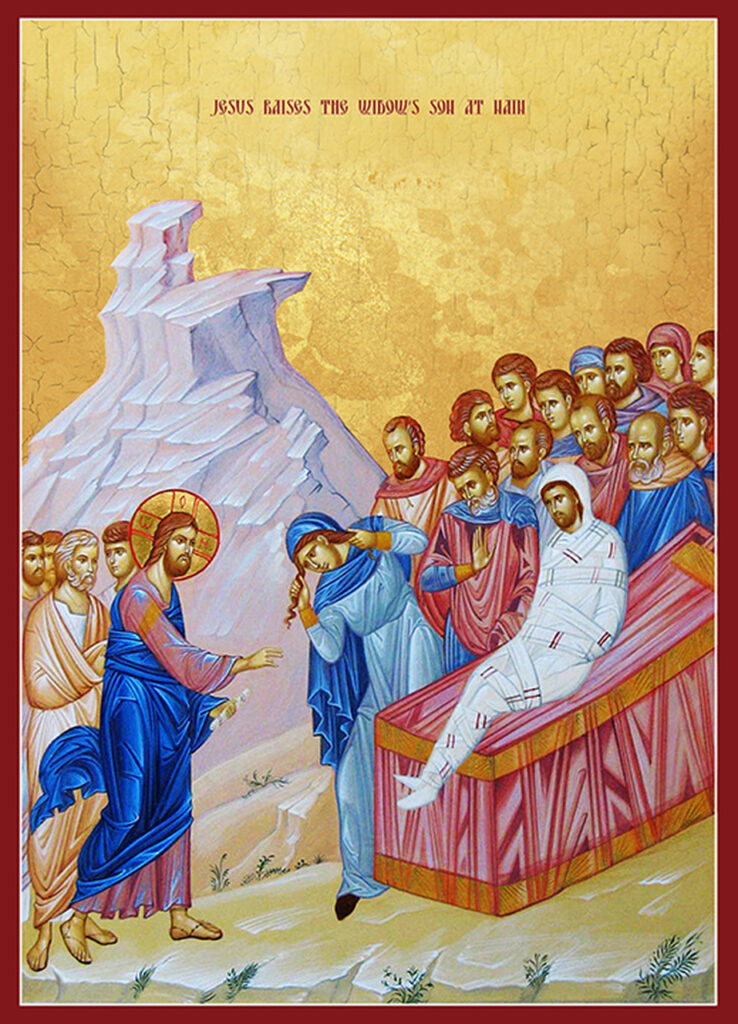
And carried on that bier to be returned to the ground from which I was taken, Christ sees me. And the Lord has compassion: not on me for I am receiving the just deserts for my prodigal living, the Lord has compassion on my mother, the Church. And He says to her, “Do not weep.” And He touches the bier and I am restored to Life, I am freed from the clutches of death. But I am left with a crisis, a decision, do I continue my prodigal living away from the heavenly City, or do I bring myself and my mother too back to the Kingdom? The Apostle starkly explains this crisis, “the wages of sin is death,” says he, “but the gift of God is eternal Life in Christ Jesus our Lord.” (Romans 6:23)
My dear brothers and sisters in Christ, God hears the cries and laments of our mother, the Church, for us as we wander away from Him, and He comes to each of us and touches the bier on which we are carried—the bier of our sin, the bier of our ego, the bier of our defiance—and we are brought back to life through no work of our own. Do we use this as an opportunity to sink into further darkness, believing this to be a repeatable event, or do we return to the heavenly City? But tomorrow is not promised to us, tonight the Lord may come to me and say, “Fool! This night your soul will be required of you.” (Luke 12:20)
“Beware, brethren,” says the Apostle,
lest there be in any of you an evil heart of unbelief in departing from the living God;
Hebrews 3:12–15, Psalm 94:7–8 lxx
but exhort one another daily, while it is called ‘Today,’ lest any of you be hardened through the deceitfulness of sin.
For we have become partakers of Christ if we hold the beginning of our confidence steadfast to the end,
while it is said:
‘Today, if you will hear His voice,
Do not harden your hearts as in the rebellion.’
Let us then, before the night, turn back to the heavenly Kingdom, following the laws of Christ which are only that we love truly, love as Christ loves us, (see John 13:34) for indeed Christ calls to us,
Come to Me, all who labour and are heavy laden, and I will give you rest.
Matthew 11:28–30
Take My yoke upon you and learn from Me, for I am gentle and lowly in heart, and you will find rest for your souls.
For My yoke is easy and My burden is light.
Let us repent, that as we were dead in sin and restored to life in Christ Jesus, we may partake of the Resurrection and receive the Kingdom of God.
That we may offer true praise, glory and worship to our great God and Saviour Jesus Christ, Who has restored us to life that we may follow Him, together with His unoriginate Father and the All-holy, Good and Life-giving Spirit. Amen.
Brethren, the God and Father of the Lord Jesus, he who is blessed for ever, knows that I do not lie. At Damascus, the governor under King Aretas guarded the city of Damascus in order to seize me, but I was let down in a basket through a window in the wall, and escaped his hands. I must boast; there is nothing to be gained by it, but I will go on to visions and revelations of the Lord. I know a man in Christ who fourteen years ago was caught up to the third heaven — whether in the body or out of the body I do not know, God knows. And I know that this man was caught up into Paradise –whether in the body or out of the body I do not know, God knows — and he heard things that cannot be told, which man may not utter. On behalf of this man I will boast, but on my own behalf I will not boast, except of my weaknesses. Though if I wish to boast, I shall not be a fool, for I shall be speaking the truth. But I refrain from it, so that no one may think more of me than he sees in me or hears from me. And to keep me from being too elated by the abundance of revelations, a thorn was given me in the flesh, a messenger of Satan, to harass me, to keep me from being too elated. Three times I besought the Lord about this, that it should leave me; but he said to me, “My grace is sufficient for you, for my power is made perfect in weakness.” I will all the more gladly boast of my weaknesses, that the power of Christ may rest upon me.
— Second Corinthians 11:31–33, 12:1–9
At that time, Jesus went to a city called Nain, and his disciples and a great crowd went with him. As he drew near to the gate of the city, behold, a man who had died was being carried out, the only son of his mother, and she was a widow; and a large crowd from the city was with her. And when the Lord saw her, he had compassion on her and said to her, “Do not weep.” And he came and touched the bier, and the bearers stood still. And he said, “Young man, I say to you, arise.” And the dead man sat up, and began to speak. And he gave him to his mother. Fear seized them all; and they glorified God, saying, “A great prophet has arisen among us!” and “God has visited his people!
— Luke 7:11–16