
In the name of the Father, and of the Son, and of the Holy Spirit, one God, Amen.
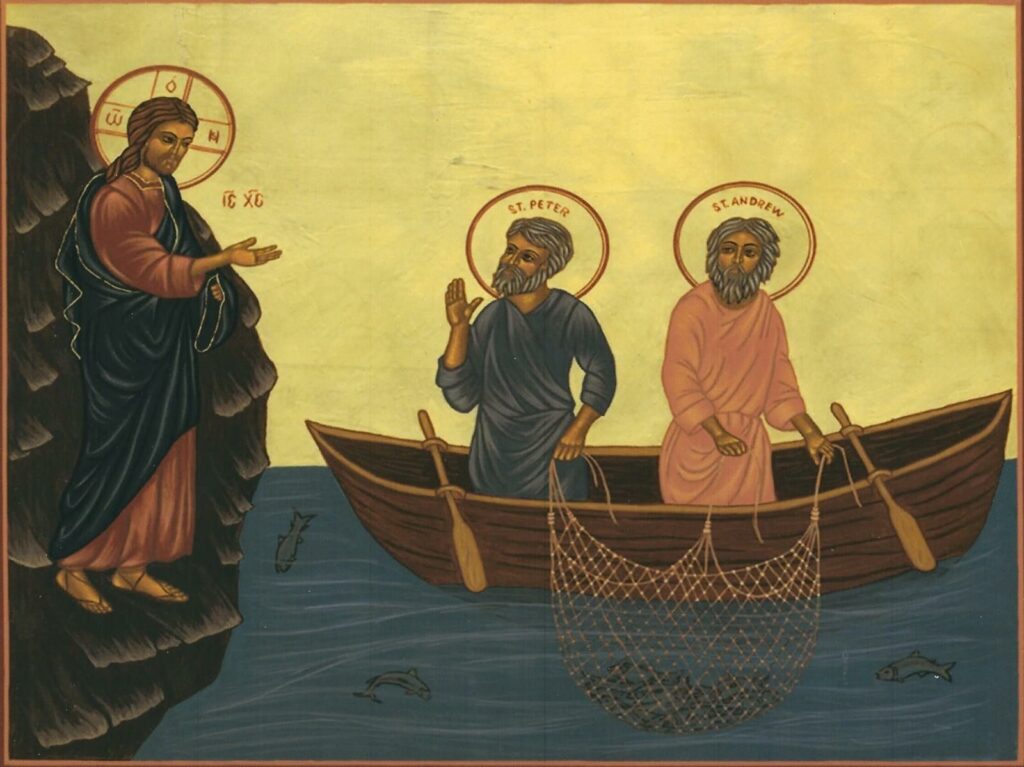
“Master,” say the leaders of Judea, the priests and the prophets, “we toiled all night and took nothing!” For indeed, from Abraham through to the blessed Forerunner, the people of God have toiled, have worked, have laboured, and were still awaiting the fulfilment of the Promise,
Blessing I will bless you, and multiplying I will multiply your descendants as the stars of the heaven and as the sand which is on the seashore; and your descendants shall possess the gate of their enemies.
Genesis 22:17–18
In your Seed all the nations of the earth shall be blessed, because you have obeyed My voice.
We, too, toil, we work, we labour, but to us it has been granted—not by our own efforts but by the grace of the Lord—to be witnesses of the Resurrection, to have the fulness of the revelation of God; Christ has let us reap the blessings of Life. But, whereas Peter recognised the great blessing he has received and his own unworthiness, “Depart from me, for I am a sinful man, O Lord,” I remain unmoved. I have received an immeasurable blessing from the Lord and I shrug my shoulders and continue my life unchanged: I have, in the words of the Apostle we have heard today, “accepted the grace of God in vain.”
Yet Judgement awaits. St Paul had already told the Corinthians,
Therefore we make it our aim, whether present or absent, to be well pleasing to Him.
Second Corinthians 5:9–11
For we must all appear before the Judgement Seat of Christ, that each one may receive the things done in the body, according to what he has done, whether good or bad.
Knowing, therefore, the terror of the Lord, we persuade men; but we are well known to God, and I also trust are well known in your consciences.
My dear brothers and sisters in Christ, we have received a great blessing—Life, eternal Life, Life without end—but we cannot remain as we are: we must recognise our sin that we may purify ourselves, that we may repent, that we may turn again to the living God. “Behold,” says the Apostle, “now is the acceptable time; behold, now is the day of salvation,” and he tells us how we may do this, which is to say how we may carry our own crosses in the way of Christ.
through great endurance, in afflictions, hardships, calamities,
beatings, imprisonments, tumults, labours, watching, hunger;
by purity, knowledge, forbearance, kindness, the Holy Spirit, genuine love,
truthful speech, and the power of God; with the weapons of righteousness for the right hand and for the left;
in honour and dishonour, in ill repute and good repute.
The disciples, “left everything and followed Him.” This is not the calling of all Christians. In the words of the Epistle to Diognetus,
For the Christians are distinguished from other men neither by country, nor language, nor the customs which they observe. For they neither inhabit cities of their own, nor employ a peculiar form of speech, nor lead a life which is marked out by any singularity. The course of conduct which they follow has not been devised by any speculation or deliberation of inquisitive men; nor do they, like some, proclaim themselves the advocates of any merely human doctrines.
Epistle of Mathetes to Diognetus, V
Yes, indeed we are not called to leave everything: and yet we are. The Epistle continues,
But, inhabiting Greek as well as barbarian cities, according as the lot of each of them has determined, and following the customs of the natives in respect to clothing, food, and the rest of their ordinary conduct, they display to us their wonderful and confessedly striking method of life. They dwell in their own countries, but simply as sojourners. As citizens, they share in all things with others, and yet endure all things as if foreigners. Every foreign land is to them as their native country, and every land of their birth as a land of strangers. They marry, as do all others; they beget children; but they do not destroy their offspring. They have a common table, but not a common bed. They are in the flesh, but they do not live after the flesh. (Second Corinthians 10:3) They pass their days on earth, but they are citizens of heaven. (Philippians 3:20) They obey the prescribed laws, and at the same time surpass the laws by their lives. They love all men, and are persecuted by all. They are unknown and condemned; they are put to death, and restored to life. (Second Corinthians 6:9) They are poor, yet make many rich; (Second Corinthians 6:10) they are in lack of all things, and yet abound in all; they are dishonoured, and yet in their very dishonour are glorified. They are evil spoken of, and yet are justified; they are reviled, and bless; (Second Corinthians 4:12) they are insulted, and repay the insult with honour; they do good, yet are punished as evil-doers. When punished, they rejoice as if quickened into life; they are assailed by the Jews as foreigners, and are persecuted by the Greeks; yet those who hate them are unable to assign any reason for their hatred.
Let us, then, dear brothers and sisters, acknowledge both the great blessing we have received and our own unworthiness, let us—while remaining where we are—separate ourselves from this world by our conduct, by our love for all others, by our endurance of hardships with peace: let us repent! That we, too, may be called by Christ and inherit the Promise: that in Christ we shall be blessed, because we have obeyed God’s voice.
To our crucified and risen God and Saviour Jesus Christ be all glory, honour and worship, together with His unoriginate Father and the All-holy, Good and Life-giving Spirit. Amen.
Brethren, working together with him, we entreat you not to accept the grace of God in vain. For he says, “At the acceptable time I have listened to you, and helped you on the day of salvation.” Behold, now is the acceptable time; behold, now is the day of salvation. We put no obstacle in any one’s way, so that no fault may be found with our ministry, but as servants of God we commend ourselves in every way: through great endurance, in afflictions, hardships, calamities, beatings, imprisonments, tumults, labours, watching, hunger; by purity, knowledge, forbearance, kindness, the Holy Spirit, genuine love, truthful speech, and the power of God; with the weapons of righteousness for the right hand and for the left; in honour and dishonour, in ill repute and good repute. We are treated as impostors, and yet are true; as unknown, and yet well known; as dying, and behold we live; as punished, and yet not killed; as sorrowful, yet always rejoicing; as poor, yet making many rich; as having nothing, and yet possessing everything.
— Second Corinthians 6:1–10
At that time, as Jesus was standing by the lake of Gennesaret, he saw two boats by the lake; but the fishermen had gone out of them and were washing their nets. Getting into one of the boats, which was Simon’s, he asked him to put out a little from the land. And he sat down and taught the people from the boat. And when he had ceased speaking, he said to Simon, “Put out into the deep and let down your nets for a catch.” And Simon answered, “Master, we toiled all night and took nothing! But at your word I will let down the nets.” And when they had done this, they enclosed a great shoal of fish; and as their nets were breaking, they beckoned to their partners in the other boat to come and help them. And they came and filled both the boats, so that they began to sink. But when Simon Peter saw it, he fell down at Jesus’ knees, saying, “Depart from me, for I am a sinful man, O Lord.” For he was astonished, and all who were with him, at the catch of fish which they had taken; and so also were James and John, sons of Zebedee, who were partners with Simon. And Jesus said to Simon, “Do not be afraid; henceforth you will be catching men.” And when they had brought their boats to land, they left everything and followed him.
— Luke 5:1–11